
Part One : Maladies
There is wisdom in the idea that we spend the first thirty years of our lives trying to model the world, and the rest of our lives trying to make our model fit the world. The desire to control, to grab more than we need, to deceive and manipulate others, to seek retribution for perceived hurts.
I call all these common human weaknesses maladies.
Their origins are described in this part, and their remedies in the next.


|
The social mind |
|
As recently as 30,000 years ago, Homo sapiens co-existed with Neanderthals. We shared a large brain with our stockier, tougher co-habitants, both species having long since split from shared tree-bound ancestors a few million years earlier. We were encouraged out of dense forests onto newly evolving savannas - large grassy areas where trees were more sparsely spread, and hence offered no canopy as camouflage. The consequential vulnerability to predation of these open spaces encouraged bipedalism - we literally had to find our feet so as to avoid undesirable attention from many dangerous animals. But this mobility did not directly result in a larger brain. Whilst there is some debate on that evolutionary history, the combination of greater cognitive ability and hands liberated from transporting us around lead to a higher role constructing things. And the benefits that ensued created a virtuous cycle that in turn yielded a larger brain and more dextrous hands, not least the evolution of the opposable thumb. But this was still a slow change, spanning millions of years during which two branches of humans evolved with qualitatively different mental capabilities. In essence, Homo Sapiens developed social skills in order to work in groups, whilst Neanderthal tended to operate individually. Their brain was less capable socially, allowing modern man, with his sociably capable brain to prevail. Again, there are mixed reports about the demise of the Neanderthals, so we will always lack a thorough understanding of quite why we survived and they did not. A powerful inheritanceWhatever the cause, we are endowed with a brain powerful enough to handle both great complexity and great volumes of information. But much of what constituted daily life for many thousands of generations was pretty basic - our complex modern life has been in existence for but a twinkling of an eye. So why did we develop such a powerful brain? The Social Brain Hypothesis was the conclusion of research that found a correlation between brain size and complexity of social groups. There is indeed such a correlation, but the main correlation is actually between long-term pair-bonding and brain size. There are two factors here. First, to risk all for one partner, thereby forgoing other mating opportunities, demands that you choose wisely and enquire deeply into the nature of your chosen partner. Second, cohabitation is cognitively very demanding as you must be in constant tune with the needs of your partner, your offspring, your own needs, and the careful path taken that accommodates all of these. There is no doubt also that a larger human brain was required to handle the sheer number of relationships that arise when humans live in groups. To recall what you said to whom, who owes you a favour, who you must be wary of, and so on, is very demanding. But what about the large brain of the Neanderthals? It appears that their lineage followed a path of individualism, where brawn was needed for self-sufficiency. They were not just bigger bodied and bigger brained, they also had larger eyes, and it appears that a large part of their brain was taken up by the visual cortex to enable better foraging for food. In summary, then, Neanderthals retained the more prevalent primate path of individuals operating in loose, small groups. Homo sapiens followed a social, co-operative route, operating in larger, more cohesive groups. The advantages of any change, however, are often accompanied by some disadvantages. A large brain that can understand what others are thinking is a reflective brain. So when humans get depressed, for example, they also reflect on that undesirable state, thereby sustaining and exacerbating that malady. In a nutshell, a brain blessed with a massive frontal cortex - the high level thinking part of the brain - is vulnerable to mental illnesses in a way that would never have afflicted the Neanderthals (nor their modern day 'thug' equivalents ... humans mated with Neanderthals, so there is much Neanderthal DNA still in existence). A cultural revolutionHowever, we acquired a large brain in order to gain social skills, and we did so in large part because of the synergistic benefits of cooperative group behaviour. When a wild beast could only be slain by a coordinating group of hunters, then it paid to work together in that common enterprise and subsequently to equally share the spoils - even with those 'back home' as they also had their part to play in making home homely, for example. A large brain also enabled innovative thinking that lead to the wheel and a long, long series of developments that had a gigantic effect on our lives. Because we could make vehicles to transport ourselves around, for example, we were not trapped by our bodily mobility. The salient point to be made here is that our cultural development eased the burden on our genetic evolution. It was much faster, and much more focused. To actually start to cooperate, we fundamentally had to learn to communicate, a step that the Neanderthals did not appear to take. We necessarily had to develop language in order to cooperate. This development of language was a massive differentiator, enabling Homo Sapiens to coordinate activities in a way that no other primates in existence today come close to. When language was eventually encoded in books, transmission of culture took off in leaps and bounds. And this leads to another important matter - our genetic development embraced this cultural development. It adapted to include cultural acquisitions, simply because it was so powerfully effective at supporting us as a species. Those would could prosper as a result of the acquisition of centuries of culture would have a large edge on those who were only equipped with a genetically determined set of behaviours. The latter had to rely on the time consuming acquisition of skills via first hand discovery, or by copying others, both error prone activities. A consequence of this genetic embracing of culture is that the brain evolved to to develop via the cultural transmission of the ways of life. A child's brain became a cultural blank slate - a tabula rosa. An important feature of this blank slate is that it is generally an unquestioning one - children absorb culture at face value. This has very significant consequences. But just as with a large brain, a blank slate exposes humans to problems. A need for cultural transmission leaves a child exposed to the nature of the environment he or she grows up in. It cannot be understated how profound this matter is. A child born in Pakistan will most likely become a Muslim and become infused with a life style, morals and ethics that are entirely different from a child born in Sweden, for example. I am not declaring either country to be superior to the other - merely that it is circumstance of birth and the predisposition to have a cultural blank slate that largely steers development and therefore life outcomes. Genetics has taken a gamble here. But a generally valuable and successful one, since the advantages of a rapid acquisition of culture is mostly a supportive one. However, just as a large brain provides a breeding ground for mental illnesses, a cultural blank slate is open to abuses like indoctrination. It is important to note a clear distinction between cultural skills and social skills. Whilst the former will include some social norms and traditions, such as praying before a meal, our large brain is still required to learn social skills and knowledge are, in large part, quite ad hoc in nature. The culture you are born into will not pass on personality details of all the people you meet - of their quirks and behaviours. So a powerful brain was required to slowly acquire social relationship skills on top of cultural ones. Uniting in groupsWhen we joined forces as groups, connected by language and shared goals, we satisfied individual needs for food and shelter cooperatively and collaboratively. We reaped a synergistic benefit since the whole group often had more capability than the sum of the individuals. It is crucial to point out that this is not at odds with the survival of the fittest generalisation from the works of Charles Darwin. We still needed to satisfy personal needs, but apart from mating, groups helped us meet those needs. Darwin himself also felt this way, but too often, a simplistic selfish message has prevailed. Indeed, the founding Americans grabbed the concept of Social Darwinism and ran with it, promoting the rights and potential of the individual as paramount. Well almost. They certainly played down the benefits of cooperation, even though individual success in modern life is virtually always reliant upon it. It is worth illustrating the fundamental validity of cooperation in case it is seen as a fragile matter concerning only humans. Life started on this planet in an absolutely individualistic manner with unicellular creatures. They prevailed for millions of years (and still dominate the planet), but some eventually merged into multicellular creatures. Here, there was a necessary subordination of roles to satisfy the collective benefit - each cell had its place and role in the life of the creature. In well established multi-cellular organisms, this subordination to the benefit of the group extends to apoptosis - cells will be signalled to die if they are deemed to be of no continuing value to the organism as a whole. Humans are a splendid example of multi-cellular organisms - examples of this group collaboration. Heart cells reliably pump blood around your body without knowing anything about the ultimate goal of such behaviour except that it keeps them sheltered and nourished from the food that you consume. These collaborating collections of cells are exposed, however, to anarchy - where some cells revert back to selfish ways, as might take place as a result of genetic mutation. Cancer cells are an example of such a reversion, where the normally constrained cell growth is transcended, and the corporate body is then placed in a position of extreme risk. So our immune system evolved to try to deal with such miscreant cells, along with inevitable threats from outside the corporate body. At the macroscopic level, societal groups succeed when individual needs are tempered by group needs. A balance is achieved between the needs of the individual and those of the group. It is no surprise then that humans have genetically evolved in a similar way to our constituent cells. We are born to cooperateThis means that we are born to thrive in, and need company. This is illustrated by the degree to which loneliness and isolation can be extremely deleterious to health. If in doubt, consider the devastating effect of solitary confinement and social ostracisation. We have actually evolved to feel good when we help others - to have a sense of togetherness, or collective harmony when we can work together. It is not some fickle little thing - it is deeply ingrained in our make-up (with some exceptions of course). In scientific research, children as young as two will spontaneously pick up a dropped item by an actor in front of them - they want to help without being explicitly told to do so. It is facilitated by empathy - a sense of feeling what you perceive others to be feeling - that cooperation has evolved within us. Some animals demonstrate empathy, but it is not so deeply entrenched as in humans. If you feel good helping others, and they necessarily gain from that also, then you have a form of win-win situation. This is in part why cooperation has flourished, especially in Asian and Scandinavian countries, where they favour the group ahead of the individual. In Denmark, this is actually formalised in Jante Law, which purposively seeks to stop the individual standing out. They adopt a very egalitarian life style, and in spite of a harsh climate often head the list of the happiest countries in the world. This should bring home the health and unifying benefits of a cooperative mindset. In the US, and to a lesser degree in the UK, the individual is king, and this can result in unhealthy inequality and a society divided between the haves and have-nots. Twin forcesHumans are therefore clearly driven by two forces, not one - we are not purely selfish creatures that flex a little to get our own way. We have these selfish needs, but we also thrive when working and living in concert with others. We need others, and put many of our individual needs to one side because of others. This duality is at the heart of politics, where the Left seeks equality for the masses, and the Right seeks opportunity and reward for the individual. They are both correct, but the middle, balanced view is often deemed to be weak because of compromise. When group cohesion takes precedence, everyone looks out for everyone else, and trust also elevates. It is common practice for Danish mothers, for example, to leave their baby outside in their pushchair for fresh air while they drink their coffee inside - they can entirely trust that it is safe to do this. When competition has the hot seat - especially when geared up to brutal levels within the Neoliberal Capitalist Economic model - then welfare and trust can degrade rapidly. It becomes a lose-lose situation because those who become rich cease to relate to those who are not, but still have to share the same streets, replete with litter and pot holes that are no longer costed as important concerns in a cash-starved welfare state. This degradation is already apparent in the UK after years of Austerity measures. Investment in groupsWhilst we have evolved to be cooperative, it can be expensive for us in terms of effort put in versus group reward garnered in return. Our cooperative nature therefore comes with checks and measures to try to reduce the chance of a raw deal. By way of example, we will start to challenge the one amongst our little group of close friends who always seems to be short of change when it is his turn to buy a round of beers. Likewise, someone who tries to join our group of merry men may not immediately be offered a drink - it may be a membership ritual for such newcomers to get that first round in. The point here is that we protect our investment of time and resources in the groups we belong to in order to avoid being shortchanged. We tend to cooperate conditionally, therefore, even if the terms are not always as precise or prescribed as in my examples. We might fix the bicycle of a neighbour and think nothing more of it, happy to foster a community spirit. But if that neighbour starts to exploit our generosity, we may withdraw it. We belong to many groupsWhether we like it or not, we are born into a number of groups such as our immediate family who we are most beholden to, and our extended family, a matter of lesser concern. We will become a member of our community, develop groups of friends, and maybe support a football team. We may also become very nationalistic, fiercely proud and protective of our 'race'. At a fundamental level, if we are going to invest in a group, we need to be able to identify members of that group. Whilst physical appearance can often suffice to identify race, at least to a degree, membership of a tribe, for example, may require additional, unique identifying features. Some may have distinctive cuts to a part of their face as a combined tribal initiation rite and differentiating feature. Music can likewise both unite and identify a group. We are talking here about traditions as signatures of groups. The salient point is the twofold effect - to unite group members, and to separate a group from others. The uniting effect is accompanied by a dividing effect. This division is no better demonstrated than in the evolution of language. For there to be approximately 7,000 distinctly different, fully fledged languages on our planet illustrates the importance of differentiation. Papua New Guinea is a country similar in size to the American state of Texas, yet it has evolved around 850 languages. This is a result of the rural nature of life there - 80% of its people live in relatively small tribes, each necessarily seeking to identify and differentiate themselves. In some parts, transitioning from one village to the next will see a matching transition in language. What might drive a village to embark on an entirely new language that will ultimately mean that they cannot talk with their neighbours, and hence not be able to trade with them? It seems that the need to hide secrets is a key driving force, coupled with the desire to differentiate. The secretive nature arises because we are wary about people outside our group. Can we safely invest in an alien group? Will they take advantage of us? So we often protect our group by hiding its operations from others via a different lexicon. Detecting group miscreantsWhilst we may make every effort to identify and root out those who do not adhere to group traditions, or who fail to contribute fairly, there are two problems that make it hard to detect such miscreants. First, it is often easier to deceive people than be detected doing so. Second, selfish miscreants have developed skills to avoid detection. Whilst humans have developed exquisite skills and habits for being wary of potential or actual selfish behaviour that undermines a group, we often give the benefit of the doubt, itself the result of trust born of cooperative behaviour. This is often because we are busy, but also because it is very demanding to be constantly vigilant. However, we still remain wary of potential wrong doings. We are probably overly fussy about the little things some people do wrong, such as walking through a door and letting it slam in our face, in order to spot tell-tale signs of 'bad people' as early as possible. This can be readily seen in the light of the 'charm offensive' many self-serving people use to grab more than their fair share of group proceeds. They disarm people in order to forge a path to exploit them. Whilst they may paint a plausible picture to deceive, they are often caught out by the small details they fail to pay due attention to - details we seem to be fussy about. As further signs of a diligence to spot situations where someone tries to acquire more than he should, we will count our change, check over the repairs to our car and such like. Most of us have also acquired a finely-tuned sense of justice. We hate to see injustices as they might signal a break-up of the group's unwritten codes of conduct. Nations have laws of course for this very reason - protection against societal break-down. We also rapidly judge new people we meet in order to gauge how trustworthy they might be. Whether we like it or not, we will naturally compare newcomers to others in our memory and rapidly pigeon-hole them as being cast from the same mould - before we properly know about them. Trust within groups is largely predicated on familiarity and/or reputation. So the cultivation of reputation becomes a powerful force - for good and for bad. Conversely, the loss of reputation can be devastating. One of the key fuels for growth and loss of reputation is gossip - this is why we are so finely tuned into listening to any titbits that we might overhear. Most people, most of the time are nice. We cooperate, generally adhering to group rules because the benefits of doing so tend to outweigh the costs. But what happens when this is not the case? The classic example is when people move into positions of power. By doing so, they are exposed to many self-serving attractions. When they sense that by bending the rules a little, they can gain a great deal personally, they often take that risk, for the group benefit now becomes much smaller than the personal benefit. They become corrupt, and so the old proverb applies : Power corrupts. Absolute power corrupts absolutely. It is a universal reality that when gaining positions of power, humans start to become corrupt - they revert back to serving the self more directly rather than via group benefits. The only thing that can be done is to reduce the level of corruption - it is very hard to eradicate it entirely as it is never bound to specific people but to latent human tendencies. But it is vital to point out that some do not succumb to the corrupting influence of power, such as Hugo Chavez, former president of Venezuela, who helped bolster a damaged society by introducing socialist reforms. He worked for years to break the stranglehold of Neoliberal Capitalism and US Hegemony that was plunging many people into poverty. Punishing failure to cooperateBecause of the very high importance of gossip and reputation, when we discover behaviour that breaks group rules, we often readily spread gossip in order to undermine that reputation. It can and does spread fast, frequently lethal in its effect. We can likewise ostracise someone - send them to Coventry - as the English expression goes. We may, for example, reluctantly become the eleventh man in a soccer game short of players rather than risk later social exclusion as seen as 'letting the team down'. A variant on this theme is to withdraw group benefits from misbehavers - the tennis player who cheats too much may get banned from play for a few weeks until repentant, and the child may be denied Internet access if they do not help clean the dishes. If a friend fails to turn up on time on an important occasion we look to do the same back to them another time as a punishment. We literally play a game of tit-for-tat, reverting back to normal behaviour if and when the message strikes home. We may likewise keep a tally of the coffees bought for a friend and point out if too long passes before they reciprocate. In summary, we look to re-establish group behaviour when it is compromised, both for our own benefit and also others in the group. But this need for retribution can be quite negative and petty, and if we are able to rise above it, then we can become healthier. This is especially so with regard the holding of grudges, which can actually eat away at ourselves, in effect hurting the wrong person. Behaviours to work onWe have looked at some of the complexities of social life through cooperation. There are some retributive, detective and deceptive behaviours that arise from groups in addition to the more obvious behaviours that arise from individual selfishness. A lot of these behaviours are genetically driven and are often quite simplistic and one-dimensional. They have often not adapted to modern life also. We will look later at ways to rise above these behaviours to not only improve our lives, but also that of people around us - the groups we belong to. Before then, we next look at the nature of the human brain, and thereby explore behavioural problems that arise from that nature. |
|
|
|
The split mind |
|
When you awake each morning, your mind becomes conscious. You become 'alive' again, experiencing life in your conscious mind - the part of your brain that means the most to you. Whilst we all know that the conscious mind is supported by the sub-conscious mind, we make the mistake of believing that the conscious mind is both in charge, and the key decision maker. The reality is very different. The size of the conscious mind in relation to the whole brain is often compared to the 'tip of an iceberg'. But it is much more like a snowball on the iceberg - the subconscious mind is massively more powerful than the conscious mind. The conscious mind operates like the CEO (Chief Executive Officer) of a big corporation, making key strategic decisions, but otherwise delegating the day to day operations to thousands of staff. And just as in a corporation, the conscious mind does not originate all the ideas. Nor is it party to the decision making process that generates the ideas. It is drip-fed decisions, suggestions and status reports. It can steer and influence behaviour, but operations generally follow established rules, and the detailed operation of the mind, as in a corporation is outside of reach. Just as details of all the tasks of all the workers would flood and overload a CEO, details of the machinations of the subconscious mind would overload the conscious mind. BottlenecksThere are obvious reasons for this delegation of work for both businesses and human minds. If all decisions had to be approved from on high, this would create a bottleneck that would slow operations down. Likewise, just as menial administrative work is left to subordinates, so the processing of bodily senses and processes is delegated to the subconscious mind. (Subconscious 'minds' in reality, since there are actually around 100 million neurons in the gut that manages the passage of food through the digestive system). The 'bottleneck' nature of the conscious mind is evident in daily life when we become easily overloaded if asked to multi-task. By contrast, the subconscious mind is a massively parallel machine - just like the many departments in a corporation. The conscious mind is also a bottleneck because it is slow and ponderous. By contrast, the subconscious mind is fast and efficient, with each 'worker' tasked with a simple aspect of a problem. The conscious mind 'CEO' has decisions to make that arise from the collective activity of the different parts of the subconscious, so it is no surprise that it is slow to operate - it is making decisions that take the big picture into account. It would appear that the subconscious operates like the House of Commons - different viewpoints serve to create a consensus or conflict that is passed to the conscious mind. This political analogy is apt because it illustrates that we are not of one mind - we operate with a collection of different, competing ideas. We are often blind to the changes in our behaviour that arises from that competition. We are blind to many aspects of our mind and behaviour as will be revealed in the following pages. Transfer of tasksYou can see the conscious mind's relationship with the subconscious when you try to acquire a new skill. Anyone learning to drive a car can verify that the conscious mind (the neocortex in this case) is slow and lumbering. It laboriously engages the clutch and puts the car into gear at a glacial pace as you learn. It is clumsy as well as slow, demanding great efforts to sustain concentration. After enough lessons, however, if the instructor can distract your conscious mind from attending to these efforts, you may find that you can change gear and brake the car, steering into a bend without realising that you have done so. The subconscious mind had taken over - faster and slicker than the conscious mind. When a skill is deeply established, such as an elegant golf stroke, then the conscious mind is a mere observer. It is disengaged from the action because it cannot operate fast enough. So you are best advised to relax and not try to control any skill consciously. If you try to take over an acquired skill - if the conscious mind tries to meddle with an automatic skill - then the execution of that skill can be compromised. The golf swing can lose fluidity and rhythm, for example when under the spotlight of the lumbering conscious mind. A skill or memory encoded in the subconscious is called an 'implicit' memory - one that the conscious mind has no direct access to. By way of example, those skilled at the strangely hard task of determining the sex of chickens cannot explain how they do so to others. To learn, a trainee must simply watch the process repeatedly and learn visually. Talking is often a fast activity, so it is no surprise that the subconscious generates most of what we say. The conscious mind can steer and select topics, but rarely constructs the sentences. You can see when it does because a person will look away and talk slowly and deliberately. Likewise, the conscious mind does not always catch a subconsciously generated sentence before it is spoken, so we often follow such sentences with the words "I did not mean to say that". E.M.Forster had this to say on the matter : "How do I know what I think until I hear what I say?" Next time you are talking to a friend, it is worth observing where your words comes from. Try to see that the stream is too fast for your conscious mind to generate. It can be amusing and enlightening to realise this. EconomyThe brain is remarkably power hungry. It consumes about 25% of the body's energy, yet is about 2% of the body size. Because of this tendency to be fuel-greedy, the brain has evolved an economical nature. It tries to reduce energy expenditure as a priority. This has profound effects on the way the brain perceives and responds to the world. The subconscious mind works with a kind of fixed budget, choosing to approximate understanding rather than expend the energy needed to be as accurate as possible. For example, if you meet someone new who looks like someone you already know, the subconscious will assign some of the attributes of the other person to the new person. As you learn more, this approximation will be refined. This economical nature has a bearing on another subconscious feature - a very powerful desire to rapidly and constantly understand what is going on around us. The subconscious prefers to be swift and sure about a judgement than wait to fill in the gaps in order to be correct. The subconscious mind hates uncertainty! It is happiest with coherent stories about the world, even if they are loose with the truth. This is why we find ourselves pigeon-holing strangers and judging their behaviours. It is an automatic behaviour of the subconscious mind. It has served our ancestors to operate this way - to have a swift understanding of others, and therefore of potential danger, even if such rapid judgements subsequently prove to be flawed. These speedy judgements are not limited to the assessment of strangers, but are a far more pervasive matter that intrudes into all aspects of our lives. As a simple example, if you read "Henry approached the bank with a gun in his hand" in a book, your subconscious would most likely conjure up an image of a bank robber. It makes a fast, best effort guess at what is meant. If, instead, I had said "Henry approached the bank with a fishing rod in his hand", you would have conjured up an entirely different image, with the bank on the side of a river. (Our conscious mind might, however, have intervened to point out the ambiguity of the word 'bank'). If I asked you "How many animal pairs did Moses take onto the Ark?" it is likely that you would have concentrated on an assessment of the animal categories rather than realise that it was Noah, and not Moses who saved the creatures. The subconscious operated economically, preferring a swift assessment ahead of a slower, more accurate one. It saw that the question felt reasonable - a biblical figure leading animals on to an Ark. But it did not dwell on the precise name of this biblical figure. It failed to do so because the focus of its attention was on the animal counting. This exposes a key feature of the subconscious mind. It works very literally, generally not questioning the legitimacy of what it is told. Because the conscious mind chose to be relaxed - in part because the subconscious did not flag the question as spurious - it did not spot the subconscious mistaken identity. Lazy conscious mindIt is not only the subconscious mind that works on an economical basis. The conscious mind is also very much a victim of economies. The reasons are slightly different, however. As mentioned before, it is a tiny part of the brain, and therefore has limited resources. It is easily overloaded, so operates lightly as much as possible, often adopting a lazy posture in order to preserve energy. For example, our subconscious will label a pretty lady as safe, and because the conscious mind will not be put on alert, it takes the easy, lazy option of accepting the subconscious judgement. It runs on idle, only loosely vetting the behaviour of this lady, who might turn out to be someone who belies her looks - a wolf in sheep's clothing. The conscious mind is likely to be lazy when we are happy and relaxed. A good mood tends to be correlated with safety, so we are then less vigilant about what our subconscious tells us about the world. We take the subconscious judgements for granted, and this can leave us exposed to problems. Overloaded conscious mindThe conscious mind is the vigilant party in the brain, but only, as you have seen, if it chooses to be. It works with doubt and uncertainty - the subconscious does not - thereby making it able to catch false subconscious assumptions. But if it is already busy or overloaded with tasks, then its ability to vet subconscious information is limited. It tires very easily, which is partly why it often adopts the lazy attitude. If you want to convince someone of something, you should keep their conscious mind busy so that it does not vet what is passed to the subconscious. The subconscious will believe what it is told in the absence of conscious vetting. This is probably what happens with farcical stage hypnotism behaviours. There is a famous psychological experiment that illustrates what happens when the conscious mind is occupied. You can find it on the Internet. A video of basketball players was shown to students who were told to count the number of passes made. This is the activity that kept the conscious mind busy. So busy, in fact, that most students missed seeing a man in a Gorilla costume weave in and out of the basketball players. It is hard to believe, but we can indeed be readily blinkered when overloaded. When it is overloaded, the conscious mind will also start to make mistakes on social matters. We will let prejudicial and selfish thoughts slip out. Psychological research also illustrates that when the conscious mind has been busy being vigilant fighting inappropriate responses from the subconscious - for example when we are holding back ill-thoughts of someone we are with - the effect can be accumulative. So we can swiftly become drained and stop vetting the subconscious. Hunger and other bodily needs can also serve to drain our conscious mind energy levels. Alarmingly, it has been noted that Judges are much more likely to be lenient immediately after eating and increasingly harsh as the next meal approaches, where hunger starts to tire them, and sentences are issued that reflect their angst. By the same token, you should hope that the examiner marking your essay has just eaten. But also, you should hope that the essay assessed before yours was poor quality - a high quality prior essay will likely see your essay marked down as a result of 'priming' by that prior essay. Priming is a form of subliminal conditioning - the examiner is unlikely to be aware of their primed biases, and therefore it is hard for them to make compensations. As with much of the brain's behaviour, we are often oblivious to these types of effects. We not only know very little about our subconscious but very little about our conscious mind also! Automatic behavioursYou can directly experience the automatic behaviour of the subconscious mind in a very revealing manner if you undertake a Stroop Test. It is fairly easy to find an online example of this test, and it is really worth taking it. It presents the names of colours, such as red, blue and green. But it often shows them using the wrong colours. You must say when the colour name matches the colour word and when not. The subconscious immediately reads the text and will present to the conscious mind that word. The subconscious will scream the word 'green' for a word 'green' shown in red, making it hard to see the red colour of the text. You cannot in fact look at a word without the subconscious automatically reading it (and reacting to it also meaning and emotion is also automatically attached to the word by the subconscious). The conscious mind struggles to over-ride the subconscious word with the actual colour of the text - the task in hand. The subconscious will continue to present you with the text name rather than the colour as the programming is so ingrained, but will gradually stop doing this after time. This intensity of programming and the ability for it to be changed are key matters in this book. And as the conscious mind labours on this task - fighting to over-ride the subconscious response - it will tire. Auto-pilotBecause the subconscious mind is faster and more efficient than the conscious mind, the brain tries to pass control of vast swathes of our lives over to automatic responses in the subconscious. Most of what we do in life becomes delegated this way by about the age of 30. The net effect is that we actually do not live very much in the conscious mind - we literally operate on 'auto-pilot'. A consequence of this is that our understanding of the world effectively becomes entrained and entrenched - we spend the first 30 years of our life trying to model the world, and then are in danger of spending the rest of our lives trying to make the world fit our model! The reality is that all of us live the majority of our days on auto-pilot, mostly very much unaware that we are doing so. We may be consciously aware of our days (but this is actually quite questionable), but we certainly are not in charge of them. We have unwittingly delegated most of what we do to our subconscious mind. The automatic behaviours that we have generated over the years are the main focus of this book. We continue to create automated responses to new scenarios, but rarely do we seek to influence how we automate our lives. It is criminal that we are not taught this reality in school because the ability to shape our lives is a vital skill. Decision makingThere is a parallel between short- and long-term memory and the conscious and subconscious minds. Short term memory is tiny in capacity and fleeting. Long term memory is vast and enduring. Likewise, the conscious mind has a tiny capacity and gets tired easily, and the subconscious mind is vast with great stamina. I draw attention to this parallel because when we have complex decisions to make, out assumption that such involved, important matters should be the preserve of the conscious mind is often incorrect. It is the subconscious mind that has the raw power to handle involved, multi-factorial problems. The conscious mind is too slow and limited to cope. The crucial consequence is that we are advised to let the subconscious mind mull over problems rather than labour consciously on them, especially where very different factors have to be weighed against each other. This even extends to matters where we might instinctively feel uncomfortable about delegating to our subconscious. For example, when buying a house, the conscious mind cannot readily equate the value of location with the price of the house or the size of the garden. We can go around in circles if we try to calculate logically. But left to the subconscious mind, an answer can be readily forthcoming. The subconscious does not always respond with a direct answer, such as "42 Acacia Avenue" for the house of our dreams. When deciding on what to eat as a dessert in a restaurant, for example, we get a feeling about what we want. As we scan through each menu item, we will feel good or bad or indifferent about each choice. The subconscious not only chooses to communicate via feelings (hence the validity of 'gut-feeling'), but it will rarely give an explanation for why. Alas, although these gut-feelings have existed for countless millennia, most of us have stopped tuning into them, to our detriment. The conscious mind may feel that it is thinking, but often, it is merely receiving the results of subconscious machinations. As mentioned at the start, the myriad of 'agents' that make up the subconscious mind will decide amongst themselves the best option to take, but will leave no audit trail of their deliberations. So the conscious mind is denied an understanding of decision making by the subconscious. This is worth reflecting upon - we frequently make decisions, but often really do not know why. But it is not quite that simple. The subconscious is quite happy to generate a fabricated guess at how a decision was arrived at if interrogated by the conscious mind. It hates uncertainty, so it is happy to do this, not really caring that it is only a guess. This is a cause of one of many forms of delusional, irrational human behaviours - we will decide upon something, will not know why, and we will conjure up a reason that is incorrect, but we will believe it to be true. You can hopefully see that rationality is a casualty of the compromises made by the brain for energy and efficiency reasons. But the conscious mind does come into its own when calculations are required. The subconscious can handle mechanical matters such as 5 + 7, or 5 * 7, where we have automated the knowledge. But 17 + 35, for example, falls outside of that knowledge, so the conscious mind must intervene, even if it still farms out sub-calculations to the subconscious (such as 7 + 5). The subconscious is also particularly poor at statistics. Even professors of statistics can be caught out by statistical problems if they try to rely on their subconscious instinct. By way of example, if asked how many children in a class would be needed to have a 50/50 chance of two of them having the same birthday, most people's natural instinct would be to divide 365 days in half. The actual answer of 23 is way beyond instinct. (It is this low because we have not specified which day of the year must be the shared birthday. If I had asked you how many people it would take to have a 50/50 chance of finding one that would match your birthday, it would be 183). Now we have a second source of behavioural problems - the very nature of our brains can undermine our quality of life. Detecting and rising above these behaviours will also help us improve our lives. |
|
|
|
Beliefs |
|
The central control system within the subconscious mind is a combination of two modules. The Reticular Formation (RF) receives about 100 million signals a second from the senses and from internal organs and processes. Part of this gigantic volume of information is processed internally by the RF. The remainder is processed by the Reticular Activating System (RAS), a kind of 'sentinel'. It uses the RF to communicate responses back to the body and other brain regions. Whatever you see, hear, feel and taste passes through this system. The RAS/RF combination is essentially a goal seeking machine, filtering out a large part of this massive stream of signals, and responding to those deemed important or novel. The base level goal is essentially homeostasis - keeping biological organs and processes in balance. The RF carries out these processes silently without involving the RAS. For example, to ensure that the body operates at a stable temperature within very narrow limits, adjustment messages are sent to the appropriate parts of the body. The higher level goal is to try to satisfy bodily needs such as hunger, along with emotional and intellectual needs and demands. (Hunger is deemed a high level function because it requires the brain to be alerted into finding, preparing and consuming food). In order to make many of the high level decisions, the RAS uses a set of beliefs that we have established over our life-time. It seeks to both assert our beliefs, and to alert us when our beliefs are contradicted. When beliefs, or expectations based on our beliefs, are not violated, no action is taken. The human condition is one that is indeed focused on novelty - it takes the economical path of least resistance when all seems well and expected in the world. If we see a man walking backwards along the pavement, we are alerted to this as a matter of novelty - it violates our expectations. Our embedded belief is that people walk forwards in normal daily life. If someone insults you, this may violate your current belief that you never behave in a way that would warrant insult. So the amygdala - the emotional centre in your brain - is triggered to generate an emotional reaction. And the frontal cortex in your brain is then told of the violation. It is crucial here to see that the emotions can precede the intellect, so it is very easy for them to influence your reaction. You may now engage other beliefs that urge you to fight back against insult, angry with this person for showing disrespect. This anger may be guided by beliefs that disrespect must be dealt with by a blow to the jaw, or an aggressive stance and tone of voice. If we are challenged into explaining why we behaved that way, our beliefs will provide a self-justifying response. We may allow these automatic subconscious responses to proceed, or we can consciously choose to override them, the key tenet of this book. Belief processing sequenceThe general nature of beliefs creates a well trodden sequence :
Beliefs have a kind of nested shape, where some beliefs spawn child-beliefs which in turn spawn further child-beliefs. But these can in turn then link to higher level beliefs, so the whole belief system can become a complex, tangled web. As we experience life, we add new beliefs, and juggle existing beliefs. These beliefs may start with conscious awareness, or may not, but they all end up embedded in the subconscious. It must be made absolutely clear that many of your beliefs are beneficial to your life. But many also do not serve you well. You may, for example, avoid playing weaker chess players because of a fear of losing, an entirely justifiable reaction to the above scenario. But only if your beliefs keep responding in the same way to defeat by a weaker player. The more you allow this automated response and justification process to play out, the more entrenched it becomes - the more likely it will happen, and the harder it will be to change it. Development of beliefs (and lying)When we are young children, the ancient, primitive parts of our mind dominate because the more recent, intellectual parts take many years to develop. This is why children tend to be direct and forceful about their needs and wants. Intellectually, because young children are blank slates, they are extremely vulnerable to influence from the environment, especially family members. The reasoning, rational frontal cortex in the brain does not actually finish development until we reach our early 20's. Until then, we learn social behaviours via cultural education and by mimicry, and we also acquire and internalise beliefs from our family and friends. It is frustrating to parents to discover their children lying to them. Most parents try to enforce the virtues of honesty, yet fail to see that children see parental deceptions and their own lying as variations on a theme. The former validate the latter - they see that daddy is telling mummy that he loves the biography that she gave him, yet the children know that he hates books, so they learn to deceive by copying parental behaviour rather than follow advice. Lying is just one form of deception . Parents also fail to see the conditioning effect of punishments for child misdeeds. Very young children will automatically seek out the path of least resistance - they will lie that they did not eat the cake, rather than incur punishment, even if they know they have been directly caught in the act. Their lies take on different flavours as they mature, choosing to deceive others with white lies rather than potentially upset them with honesty. The instinct to deceive others gets developed in parallel with the acquisition of beliefs. We learn to delude ourselves all the better to be able to delude others, it appears. When young, the beliefs we acquire are as unquestioned by the conscious mind as they will be when gradually embedded in the subconscious mind. We simply do not know enough about the world to question them. But we will change some embedded beliefs when we acquire greater life experience. However, some beliefs slip by the conscious mind 'net' and become invisibly embedded in the subconscious. Some of these beliefs we embed we actually consciously disagree with. For example, too many bad parents, alas, will repeatedly tell a child that they will never amount to anything in life. Whilst the child will be very upset and uncomfortable about this, rejecting both the idea and her parents for telling her this, she will still internalise it as a belief because of the power of an authority voice. As the saying goes, a lie repeated often enough comes to be believed. And the deep problem here is that the conscious rejection of the belief blinds the child to the internalising of it - she will not be aware that she has adopted the rejected criticism as a belief. This has ongoing ramifications as the subconscious will base other beliefs and behaviours on this embedded belief, creating a life-long tendency, in her case, to fail to amount to anything, a fulfilment of her parents' misguided indoctrinations. Each time an opportunity presents itself to her in her life, this embedded belief system will seek to assert itself and sabotage the opportunity. Likewise, bad habits can also take on a deeply rooted nature, even as they fail to serve us well. They persist as a consequence of repeated use - a damaging form of catch-22. I believe that strong emotions can readily establish and perpetuate the wrong kinds of thinking. Remember that emotions can engage before reason has time to get started (the principal emotional centre of the brain, the amygdala, is the target for many sensory inputs, which it vets before the conscious mind responds). If our emotions are strong enough, they can start blinkering and distorting our thinking. When gripped by anger, for example, the brain shifts into a state where it will focus on information that supports the anger agenda, and is literally incapable of handling positive thoughts, or anti-anger concepts. Evolution has given us, in anger, a highly focused and efficient mechanism for swift attainment of a goal - the correction of a perceived injustice. But strong emotions like anger do not fit well into modern life, and can disturb the balance in our thinking, setting us up for long term bad thinking patterns. For some, anger is addictive because the great power unleashed is remembered more than the sustained ill-feeling that follows the argument. Comfort zoneHabits can also grip by putting us within a 'comfort zone'. Even a poorly executed tennis stroke, one that is less comfortable for the body, is comfortable to our mind by its very familiarity. That its awkwardness will eventually tire us prematurely, and result in more mistakes is not recognised by the subconscious since it does not question habits and beliefs until made to do so. There is a saying about our habits that should help illuminate their fundamental flaw : "Life begins where your comfort zone ends" With an accumulation of beliefs and habits that do not serve us well, we also accumulate the negative effects of their shortcomings. We all have a vague, general feeling that a large force inside us is holding us back in many situations. But we are never really able to pin it down. It is, of course, hard to do so as it is multi-factorial, affecting us in different ways in different situations. How we react to what happens to usIt is common experience, and common 'knowledge' that we are affected by what happens to us - how external events impact on our moods, emotions and lives. It is easy to make the connection between an event - such as dropping a bottle of milk on the floor - and our 'inevitable' reaction - to get angry and upset by the mess, waste and inconvenience. We really do believe that dropping the milk - or someone treading on our toes, or finding a pound coin on the pavement - creates our emotions. But theses things do not - it is our reaction to the event that generates our behaviour and emotions. Our misunderstanding arises because we fall into the classic trap of confusing (conflating) correlation with cause We believe that situations are inherently stressful or enjoyable, but this is not the case. It is our reaction that creates stress or pleasure. Our upset reaction to the dropped bottle has become automatic. This is a mixture of belief - that when things go wrong, it is only right that we should get upset - and habit, where we fulfil the belief. But we can change these habits and beliefs. Our beliefs create an expected response, reinforced by repeated use. Our lives are based on automatic responses and the related expectations. The effect of expectations can be very subtle however. For example, we may have built up expectations or conditioning that encourages us to see happiness as achievable only via pleasures - a hedonistic attitude. That happiness is essentially a consequence of a state of mind rather than events is often missed by most people. And the net effect is that when they are genuinely happy, they will often not recognise it because it fails to match expected happiness 'criteria'. I will explain via an example. A few years ago, in the middle of a week's break, spent mostly pottering around at home, I decided to trim my willow tree. Balancing precariously with one foot on a wall and the other on a ladder, I stretched too far and slipped, dragging one arm and one leg down the rough surface of the stone wall. I went indoors to check the damage, decided it was relatively minor, and went back onto the wall to resume trimming. And that was when I felt the happiest I had done all week. My happiness came from the warm feeling of resiliency that I could carry on after a 'scrape'. It was my attitude that enabled a happy state of mind. Would I plan to repeat this incident another time to feel happy again? No, of course not. But that is not the point - it was not the event that made me feel happy as the ability to cope with the good and bad that life throws at me, and go with the flow. We also confuse cause and correlation when we attribute behaviour to a single cause. We often act in a way that has multiple causes, yet we blinker ourselves into thinking that there is only one cause. When we also attribute single causes to behaviours in others, we fall into the trap of judging them falsely. We see a mother shouting at a child and judge her for inappropriate behaviour, without knowing that her partner threatened to leave her that morning, and she discovered that she did not have enough cash to buy what she needed that morning. This is a context that makes a child squealing for sweets more painful to tolerate than normal, but which is invisible to the onlooker. Self esteemThere are many situations where the self-sustaining and reinforcing nature of our beliefs works against us. But a key problem is where our ability to do the things we want or need to do is compromised by a belief. This can be very literal, where we deem what we do to be only as good as its weakest part. For example, for many people, each time they let someone down, their self-esteem plummets. Their embedded belief is that a good person will never let their friends down. If you think that you never get to play against good squash players because you are not good enough, when you do get to face one, you might unknowingly sabotage the game in order to fulfil your belief that you are not good enough. A self-fulfilling prophecy. A key here is to let your self-esteem be guided by a holistic picture of who you are. You should see your weaknesses in balance with your strengths. And it is best to see each 'failure' as an individual event. You are not the behaviour - you are the person performing the behaviour. Let your self-esteem be guided by the whole picture and not individual events. As a very simple, but surprisingly common example, stop calling yourself a failure each time you make a mistake. This tendency to lose self-esteem can also strangely apply to positive events. When you achieve something good, your self-esteem receives a boost, but if you invest too much weight in such highs, then your self-esteem is equally fragile. You might also see the success as fortuitous - that you did not deserve it. See achievements as the icing on the cake, and move on. Likewise, rather than be dragged down by mistakes, learn from them, and also move on. It is additionally crucial that you let your self-esteem be independent of the opinions of others. We can fall into the danger of being controlled by their opinions, leaving ourselves open to even the tiniest slight. Self esteem is a form of belief system - we constantly monitor how we feel about our self, and a lot of the appraisals we make are based on our beliefs. Our self esteem will take a hit when something bad happens that violates one of our self esteem foundational beliefs. A common example is a social faux-pas, where we blurt out something that we should not have said. It need not impact our self esteem, but frequently does. ExpectationSocial pressures are a form of expectation imposed upon us by others. We can also impose expectations on ourselves that can equally damage the quality of our lives. Expectation is a kind of control issue - we expect life to go a certain way and suffer angst when it does not. Instead, it is best to have a flexible outlook, and not get emotionally attached to expectations. One of my regular expectations is to be able to make the most of the rare sunshine we get in the UK. If a week of rainy weather is followed by hot sun on the very day that I have to be stuck indoors, I can become glum, and complain about the unfairness of it all. Such a reaction, along with anger are common consequences of unmet expectations. It is much better for me to accept such circumstances and invest my energies in what needs to be done rather than what might have been. It is better for my mind to be where my body is (indoors) rather than for my mind to be where my body evidently is not (in the sun). Many of us are held back from enjoying life, from being happy, by an inverse form of expectation. We think that we cannot possibly expect to be happy until our health is sorted, the mortgage is paid off, we get our dream job, and that injury heals. Such a dependent outlook, predicated on events or things, will by its nature ensure its own perpetuation. As soon as one 'key criteria' for enjoying life is ticked off, the next item in the list kicks in - we encounter a stream of events or activities that will be deemed to equate with unhappiness or impaired life quality until ticked off. So the list never ends, and we do not allow ourselves to be happy. I waited in until mid afternoon one day for the arrival of a new cable TV box. An upgrade to my existing box, with extra bells and whistles of course. Two and a half hours after it had arrived, with much time on the telephone to the cable company support department, it not only transpired that the new box had a fault, but that I could not revert to using my old box. The failed activation process for my new box was a one-way process, it seems. They had not allowed for the possibility that a new box might not work, so I would have to wait until the next afternoon before an Engineer could come out to help me. Which meant that I was unable to watch the big soccer match on TV that evening. Of course, you would assume that I would have said to the support staff something like "I am not exactly happy about this!" But I didn't. Nor did I think of saying it. I had decided all through this that I would not let the new box (a material thing) or the missing of the TV programme (an event thing) affect how I felt. I just went with the flow. There was nothing more that the support department could do, so I accepted my plight, and relaxed in the sun. And as I relaxed there, I realised that I felt very happy. You might be wondering why on earth I should have felt so happy. I had paid for something that had not worked. I was going to miss my soccer match. And I had wasted over 2 hours to get to that position. I was happy because of how I had handled these problems. I was happy not because of some material thing. I was happy not because of some event. I was happy because of the resilience and flexibility of my attitude - I had managed my expectations very well (just as I had done when falling off the wall while trimming my tree.) To expect life to be just right before you can truly enjoy it is one of the biggest mistakes most of us make. It does not help, of course, that we are not taught the fault in such a way of thinking. But at least you now know. And if you buy into this idea, you will amaze yourself with what transpires. Some days, I just look up at the trees and say 'I am alive', and think that in all the billions of years this planet has been here, and will be here, I am indeed here, alive, in my tiny slot of time. And I appreciate life more by doing this. I live in the moment. As you might guess, research has shown that the more you live in the moment, accepting all that is around you, the happier you will be, and the longer and healthier your life will be. Expectation can be externally influenced. A mediocre rugby player will play with much more confidence, fluidity and capability when asked to demonstrate to some youngsters. Place the same player in a strong, demanding team, he may well under-perform. His expectation of performance is based on relative abilities and will change enormously in accordance with whom he plays. The very best sports men and women tend to be at the top more on belief in their abilities than in their actual abilities - their belief is so powerful that it continuously pushes them to perform better and better to meet their expectations. Tests of mental ability on some students illustrate a negative side of expectation. Those that believe that they will do well in a test will tend to do so - their expectation fulfilling itself. Those who feel stigmatised into under performing will do poorly. One psychological test pitted Black and White students against each other. As you would expect, they performed relatively equally. However, when the Black students were reminded of their ethnicity, and the baggage that came with it (from decades of entirely unfair treatment by Whites), then they performed badly. Their performed according to the stereotype created by White people. As this illustrates, expectations are a product of the ego. Now is the time to look at ways of changing beliefs and the behaviours they spawn. Beliefs sustain themselvesThere is a psychological phenomenon called priming, whereby our subconscious will urge us to do something based on something we are only subconsciously aware of. We may, for example, decide to have a doughnut, not realising that ten minutes earlier we had subliminally seen an advert for Krispy Kreme donuts, A similar effect can take place with our beliefs, when they prime us to seek out matters in life that confirm those beliefs, and to deny ideas that contradict them. We are, in effect, primed to see what we expect to see, and have a blind spot to what we do not expect or want to see. Scientists who invest years or decades in research and achieve great results and success are often extremely reluctant to let go of their beliefs when evidence starts to show that their ideas are flawed. The belief in their ideas were hard earned and they do not want them to be wasted, so some scientists will ridicule contradictory new ideas, or deny their validity in order to protect their belief investment. In a similar way, our own deeply held beliefs seek to sustain themselves. We will see the world in ways that serve to validate our beliefs. As a consequence, for example, we will more fully read and accept media articles that reinforce what we believe, and pay only lip services to articles that refute our beliefs. Likewise in conversation, we will twist and turn in order to preserve our own beliefs, morals and ethics rather than admit flaws in them, or admit that others may have better beliefs. We behave myopically, yet rarely see that we do so. Some of the most vigorously defended beliefs are religious. These beliefs can operate with such a deep foundation to a person's existence that they will actually react to contradictory viewpoints by strengthening those beliefs. There is so much at stake - embedded beliefs have become enormously powerful via repeated use - that we will act irrationally to protect them. This is why atheists and believers will rarely change the mind of the other, yet each will be hypocritically infuriated by the stubbornness of the other. Pathological criticThe subconscious supplies us with a day long stream of thoughts. We believe that we are generating them, but most percolate up to consciousness rather than start there. The subconscious is like a chatterbox, a very persistent, relentless talker, as you will know when you struggle to relax after a busy day. Unfortunately, much of the chatter is not beneficial to your health, especially if arising from flawed beliefs. Eugene Sagan describes the subconscious as a 'pathological critic' when engaged in destructive forms of chatter. This 'critic' punishes us for the mistakes we make, and taunts us for being perceived as inferior to others. It often emphasises the negative and de-emphasises the positive. And because we are so easily fooled into believing that these criticisms were created by our conscious thought, we tend to accept them without question. Why question your own mind? This has the twin effect of lowering our self esteem and of reinforcing the validity and power of these subconscious thoughts. If you succumb to the pathological critic that blames you for your mistakes, you merely serve to strengthen that critic. You are accepting its punishment and may express it in the form of negative emotion or mood. By rationalising and learning from mistakes instead, you replace punishment with action, and weaken the critic. Making mistakes is a fundamental part of the human condition - we have actually even evolved to make mistakes. Watch very young children to see this in action. If you try to avoid making mistakes, you are essentially avoiding life. Conversely, by embracing life and taking risks, you live a richer life, but thereby expose yourself to more mistakes. By yourself to make mistakes, and by avoiding punishing yourself using hindsight, you can relax and also become more spontaneous. I have tended to take all forms of criticism to heart, adopting an emotionally defensive, but submissive stance. Much like with anger, if I pause, and do not engage immediately with my instinctively rapid emotional reaction to criticism, then I can handle it more rationally. Frequently, I then find that the criticism is ill founded, and often just an outburst from someone who is using the criticism to deflect away from their own ill feelings (this is called transference in Psychology parlance). But if the criticism is indeed justified, it is much better to take action rather than dwell upon feelings of hurt. Try to rectify the cause of the criticism rather than become submerged in reactive emotions. Again, treat the criticism as an individual event, and do not see as a defining you or your self-esteem. If criticism is vague or unreasonable, ask the criticising person in a calm tone for clarification. Your tone should immediately start to placate the critic, as they are often looking for a negative reaction rather than to help you. If they remain vague, but you keep asking for clarification, they are less likely to verbally attack you in this way in the future. If you bite, and react to the vague criticism, then they will be more likely attack you again in the future. The ultimate diffuser of criticism is calm agreement. "Yes, you are right, I do talk a lot. I am, however, simply being friendly, and do try to recognise when I over do it, but cannot always get the balance right." What can they then say? Beliefs are hard to budgeBeliefs that serve us badly often do so by creating a compensation - a kind of damage limitation mechanism. For example, if we believe that we will always lose control if we confront someone, we will avoid confrontation. We gain some comfort from emotional overload avoidance as the compensation. But it means that others can take advantage of us, and we live an avoidant, diminished life. Because of this compensatory nature of many beliefs, they are hard to dislodge - we grow accustomed to the compensation payment. For example, we may revert to a sliced tennis backhand rather than go through the pain of adding a topspin backhand to our range of strokes because by doing so we lose the compensation effect. The combination of negative addition, and positive loss is too big a deterrent. But this limits our game, and forces us to approach tennis with a fear of change. |
|
|
|
Feelings, emotions, moods and thinking |
|
As you might guess from the title of this chapter, these four factors are all nicely entangled. There is a great deal of circular activity here - when you experience an emotion, it may set you thinking, which may in turn bring to mind a belief you hold, and another set of emotions is then released as a consequence. And before you know it, the emotional baggage attached to that belief will have created a mood that really had nothing to do with the original emotion. Subconscious generated feelings and emotionsIn addition to beliefs, the RAS and RF will create feelings and emotions to inform the conscious mind that something needs attending to. We will feel hunger when our body senses that our energy levels are dropping low. We will have the urge to urinate when our bladder is getting full. Strong emotions will be activated in a fight or flight situation when danger is sensed. By generating feelings and emotions, the body and subconscious mind are seeking to engage the conscious mind in order to mobilise us into action. Such scenarios illustrate a fundamental role of the conscious mind - to perform system level actions such as walking to the kitchen to prepare food in order to satisfy hunger. It is not just bodily matters that trigger the subconscious to generate feelings and emotions. It is constantly processing information out of awareness of the conscious mind, and often needs to inform us of any relevant findings. It can use words, images, feelings, emotions or a combination. You might be driving to work and get a nagging feeling that you need to do something. The subconscious will then most likely remind you that you need to pick up a prescription from the chemists at lunch time. Subconscious generated moodThere are occasions when the subconscious will make a sustained change in how you feel. Rather than generate a feeling or emotion to create a trigger to do something, it can create a mood that kind of summarises how it is feeling about the world. That subconscious summary moves into the conscious domain via that mood. How often do you awake after a splendid night of sleep and simply feel irritable for no apparent reason? Everyone seems to be talking loud and this starts to get under your skin. The very next day, with no qualitatively better sleep, you awake full of the joys of life. You do not even notice that the sound of the same loud people is simply washing over you. There are three points here. First, that we did not consciously choose the mood. Second, that we assume that we normally consciously choose our moods. Third, that we are rational in our reactions to the world, selecting mood appropriately when we rarely actually do so. The next time that you catch yourself feeling happy, try to work out why. You may find a reason, but often, no clear explanation is forthcoming. The subconscious may have decided that all is hunky dory, but will not say why. It will just make you feel good. DepressionA common mood that we all feel from time to time is depression. It is often triggered by a loss of some kind. Maybe your partner has left you, a loved one has died, or you lost self control when with friends and let loose with a fit of temper that upset some of them - you have temporarily lost their trust and it makes you feel depressed. Depression is entirely normal and healthy, and is indeed common in animals. But with our ruminating mind, we can dwell on, and therefore extend depression from an acute to a chronic condition. As a result, many people view the condition as one to be anaesthetised - to be rid of. And the pharmaceutical industry are happy to propagate that idea. But depression serves a valuable role. It literally depresses us in order to step back from normal life to pause and see what problem is presenting to us. We are forced to reflect on what has actually happened. And the nature of depression gives us greater clarity in that process as it temporarily removes the rose-tinted glasses through which we normally see life. So we have a greater chance of seeing where things went wrong. When the depression goes away, the rose tinted view of life returns. AnxietyLikewise with anxiety, where we are overly fearful of a situation and start to clam up. We can get very uptight and apprehensive. Anxiety can also suffer from aggravation by rumination. It can ultimately lead to panic attacks, where anxiety overload can start to be triggered by relatively simple event. These are called panic attacks, and they are pretty nasty. Anxiety arises when a difficult situation is perceived. It engenders emotions that make you wary of what might happen. With depression, anxiety, and other emotional disturbances, our thoughts are shifted away from the normal, relatively rational state. This can lead to extreme thinking behaviours. For example, if we have a blind date and it goes terribly wrong, we may feel depressed afterwards and conclude that we will never get a girlfriend. Likewise, when anxious, we may start to feel negatively about our abilities - we may become tongue tied in a job interview for example. If you are a very sensitive person, you will most likely be socially anxious to a degree. This may drive you to avoid wherever possible saying or doing the wrong thing. You may fall into the trap of trying to please everyone - in a sense, an excessive loyalty to the group. So extreme emotional states, or simply a highly emotional personality can cultivate extreme thinking that frequently works against us. Thinking generated feelings and emotionsEmotions are also often attached to the thoughts we have, mostly for good reason. We may plan to go on holiday but cannot work out which destination. We think about various places and see how our emotions react. It is as if we really do not know the emotional value of things we do. This is simply because we mostly don't - emotions are generally not something we create consciously, but which arise subconsciously from our conscious (and subconscious) thoughts and physical states. As mentioned before, we can end up on a kind of roller-coaster, where a thought triggers an emotion that triggers another thought and more emotions. The danger is that we are often carried this way without being truly aware of what is happening. Stacking of emotionsMy younger years were particularly affected by a combination of acute sensitivity and a very poor memory. Many days would find me unduly emotionally affected by little events, such as 'jokes' told at my expense, or remembering that I had forgotten to do something, and worrying about when I could find time to do it. Each emotional eruption would create a lingering feeling. But if there were a chain of these, I would start forgetting the causes. I would begin to feel increasingly downbeat or concerned, and try to recall why. Each recalled cause would placate the ill-feeling to a degree, but I would often not be able to remember all causes. So the whole day would be infused with this ill-feeling, and place me in a vulnerable mood. Mindfulness can nip such emotional overreactions in the bud, as we will see later. Choosing your natureSome of our limiting behaviours are genetic, such as the instinct to defend ourselves when attacked, are often not a result of acquired behaviours, but built-in, as part of our inheritance. But we never chose that inheritance. If you are able to realise that you are not the instigator of many of your shortcomings, but have inherited them, and are therefore merely the witness or victim of them, then your self esteem is much less vulnerable to their effect. Genetically predicated habits are also not beyond the scope of change. Try to remember repeatedly that the human brain is a highly adaptive device. It grows, shrinks, and evolves in response to your life experiences, and your attitude towards them. Your genes in effect give it a starting path, but genes can be switched on and off by thoughts and behaviours, allowing you much greater control over your destiny than you might imagine - genes work in conjunction with your mind, your body and your environment. In his interesting book "How your mind can heal your body", David Hamilton explores the extent of mind-body influence in great detail, along with the influence of your mind on your genetic expression. If you drew a genetic short straw and inherited many shortcomings, then you probably deserve credit for handling them. Yet most of us focus on self blame instead. This is not to say, however, that these shortcomings are not your responsibility. They are! But you need not beat yourself up for having them since you never asked for them in the first place. The status of your self esteem need not hinge on the impact of behaviours that you unwittingly inherited from ancestors that just happen to be inappropriate in modern daily life. As Paul Gilbert puts it so eloquently in "The Compassionate Mind" : "I find it amazing that so many of the desires that flow through me, and indeed all of us, were designed not only before me but before all humans." The projector in the mindBut there is a more insidious factor to account for that eludes most of us on a regular basis. What we see of the world is merely a kind of internal projection. Our senses are combined to create a facsimile of the world. We see, hear, touch, taste the world, but the results of that are indirect. They are summaries, and often impressions. There are no real colours out there - the red we see is merely our brain's expression of a certain wavelength of light. (Optical illusions can reveal some of our visual shortcomings). But on top of the projected information is a layer of judgement. We see a fabulous red Ferrari car and feel a jealousy, maybe. We hear a grating voice, but it is only so because of a judgement. It is actually just sound waves. We see someone who recently let us down, and we feel bad towards them. They become less attractive. We start to see that they are shabbily dressed, for example. Someone says something very rude and we get upset, seeking revenge. Why, your sister may ask, are you now angry? It is obvious, you reply, that he was rude to me, and therefore I must make amends. But this is just a judgement wrapped around the event. Your friend did not upset you - it was you that became upset in reaction to what he said. That was an emotional reaction on your part - he did not make that happen. You simply allowed it to go ahead - you bought into your instant subconscious judgement of the event in a way that therefore made you upset. Then you started thinking about revenge, carried by a now enflamed emotional state - one that focuses sharply on a remedial course. Your sister did not get upset, even though she was also on the receiving end of the same tirade of words. Of course, the meaning was less for her, but you too could choose a lesser meaning. The crux of this matter is that we frequently attribute our thinking to the real world. We project out internal thought out into the world we perceive. For example, we see that a young child who ran into us was behaving badly. We assign our judgement of his behaviour as a result of his impact on us and therefore the emotions engendered, and start to see that this is how the real world is. But the boy was being chased by a bully, running scared for his life. He was not misbehaving. So we got it wrong - our judgement was incorrectly projected. We often assign value and meaning to the world to try to understand it, and then conveniently forget that it is a guess, an approximation, and think instead that it is real as the judgement becomes so intertwined in what we perceive that it actually becomes real to us. If we continue to let it. A lady I see occasionally is a case in point. She is most beautiful, and therefore a delight to behold. But what makes her beauty resonate so much with me is her jollity and laughter. And it took me months to realise that I had actually been judging her, against my better intentions. I was assigning her the label of beauty and frivolity without substance. This judgement struck home quite forcefully when it occurred to me that I could talk about any subject with her and discover that she had swift and clear understanding, able to contribute in depth. I had fallen prey to a pigeon-holing that was benign, but nevertheless, invalid and demeaning. Another example might shed more light. I suffer headaches and often feel that others do not make allowances for them enough. So I can fall into the trap of feeling hard done by. Recently I found myself in a long chat with a splendidly interesting who declared that he had been suffering with a headache all day, Now I was privileged to be able to see the other side of my situation. Here, I was to be expected to make allowances for his plight. And I realised the problem others have with me, for headaches are invisible, and their effect often equally so. This man was fascinating me with his tales, and it seemed impossible that he could be struggling with a headache as he regaled his stories. I therefore found it really hard to believe he actually did have a headache, and gave him no slack as a consequence! And the point here is that my projection of him in my mind was misleading - I was portraying him as someone not really struggling with a headache. This truly felt like reality - even though intellectually knew I was deceiving myself. This concept is really, really important, so let me offer a further pair of examples. I awoke this morning with a very excited, racing mind. As I lay there, I reflected on some ideas I had and they seemed truly brilliant and revelatory. But these very same ideas not not feel like that yesterday. What had happened is that I had imbued these with my feelings. Because I felt good, the world felt good - but I saw that goodness coming from the world, not my own feelings flavouring my projection of the world. By the same token, when I feel down in the dumps, and think about things, they appear black and uninteresting for the same reason - I am projecting my mood onto what I perceive. The consequence is that this projection will make the world unappealing and withdraw me from it, exacerbating my depressed state. Such negative feedback loops are readily fuelled by this attribution error our minds frequently engage in. |
Part Two : Remedies
Our time in school may endow us with knowledge about the history of our people, or our biology, but it often omits basic training about life skills. If I were in charge of the curriculum, I would recommend 'Human nature' education from at least the age of 10. The benefit in reduced bullying alone would justify its inclusion.
|
|
Read more ... |
|
School rarely teaches us that we are of two minds - the conscious and the subconscious - and that we gradually accumulate automated behaviours in the latter, including those that do not benefit us. We are not taught that we should therefore be more involved in what we accumulate. We are also rarely told that we can change our behaviours, or how to do so. It is almost as if this is a taboo subject, and too advanced for 'mere children'. But the younger we are, the more impressionable we are, and the easier it is to change our beliefs and behaviours - to choose the direction we develop in, rather than leave it to chance and indoctrination. Children are not taught how to react to negativity from others, so tend to copy what they see on television. The media has a grizzly influence on both beliefs and behaviours, but the teaching of sound, humane behavioural understandings would serve to counter that. The media, society and family also tend to indoctrinate us into pain and problem avoidance. It is much better in fact to face life's problems rather than let them defeat us. A much better indicator of success in life is to be able to deal with setbacks than achieve good exam grades. Four categoriesI have explored four categories of human flaws in the first four chapters :
I now want to offer remedies for these maladies. By explaining how and why these maladies arise in the first place, it is hoped that the remedies will not only make a great deal more sense to you now than if they were offered in isolation, as is often the case. It is also hoped that you will therefore be more successful in applying them to improve your quality of life. It is akin to being taught why we need to learn algebra in school before embarking on the tools and skills to do that algebra. There is no direct one-for-one remedy to malady relationship here - each remedy has wide-seeping effects, but in general, the next chapter covers the first two categories, and the final chapter covers the last two categories. In any arena of self improvement, the first step is to be aware of a need or desire to change. Next is to become informed about what is going wrong. Now you will be informed about remedies. But there are two vital further steps you must take to gain the most effect. First, you must take action - reading alone will mostly just entertain or enlighten. You must make the changes that are needed. Second, you must persevere with these changes. This is no one-shot-fixes-all matter. The ways you have that fail you are like a weak muscle - you must not just strengthen that muscle, but also keep it toned on an ongoing basis. Mind-over-ways must become a way of life. This sounds like an ordeal that may not be easy to adhere to. But it is generally not long before you acquire the meta-habit of changing and guiding your habits. The force of habitWhen our behaviours - our reactions to events - gives us problems, we tend to instinctively focus on changing the behaviours. This is necessary, but targeting the beliefs that gives rise to these behaviours will give a deeper, wide-reaching effect. Treating just behaviours is comparable to modern medicine's habit of alleviating symptoms, rather than preventing or curing the causes of the symptoms. The latter is often a much trickier matter, but is all too often conveniently ignored or played down in importance. If we 'fight' some of our behaviours, we are in danger of aggravating them, since : "What we resist, persists" Habits are our 'comfort zone', even if not self-serving. The brain and body can be so determined to defend habits that when we start to change them we begin to release adrenaline and cortisone. The uneasy, agitated state that ensues can become associated with the attempt to change the habits. The net effect is that we often then withdraw back into our comfort zone, which calms us, making it all too easy for us to declare the change a bad idea and abandon it. It is therefore very easy for us to become victims of our own efficiencies, hugely coerced to stay within our comfort zones, even when they do us or the people around us no good. The vital point here is that we end up living according to how the environment feels to us, and to how we feel internally. We live in a kind of unconscious fog from hour to hour, and from day to day. To change the habits that serve us badly, we need to live more in our conscious mind. Only the wilful, determined and highly disciplined desire to change can effect that change. We have to gradually beat out a new neural path to encode a new habit, leaving the comfort of the well trodden path. We will frequently step back into the old rut, but discipline and will can move us back along the new route. The old path will gradually fade, replaced by an ever more affirmed new path. We must be diligent to maintain our efforts because even when we have virtually erased a bad behaviour, it can make a sudden, final effort at resurrection in what is called an 'extinction burst'. When you have just nailed that new golf stroke, you relax and before you know it, you have swiftly reverted to the old, awkward method that you had thought was long gone. As should be clear, changing behaviour takes sustained, concerted effort. The combination of well-established, entrenched beliefs and the behaviours arising from them are reinforced by the reluctance of the subconscious to put in the effort to change. It really does favour economy of effort above almost all else, even when the effort is going to be of benefit in the long term. Our brains are not particularly good at working with the big picture either spatially or temporally. For example, many of us would like to lose weight, but are extremely conditioned to expect regular meals and snacks. If we resist, the body tries to persist by making us feel wretched. After only a day or two dieting, our body goes into partial shutdown, preserving energy, making us feel weak and cold. It can actually conserve enough energy to make the dietary level of food intake sufficient for our reduced energy needs, so our weight loss can stagnate. One way to overcome this process is to break up the rhythm of eating by skipping meals and waiting longer before eating, so that the pangs of hunger are no longer so persuasive. We retrain our body to be happy with food when it arrives, and can lose weight without constantly craving food. Changing habits and behavioursAs described earlier, the RAS will act in good faith on beliefs and priming. To change a habit or behaviour, we must work with the RAS. So a vital key to change is to visualise, feel and start to believe in the change we want. The RAS will then start to act on this request, much as described in the many books on the 'Law of attraction', where it is claimed that we attract what we want. If we are working towards something in life, and problems are presented that seem to block us, we can start to condition our thinking to see problems as surmountable and more as challenges than barriers. The RAS will then start to get the gist of this and act automatically in this manner. When trying to create a new habit rather than erase an old one, then visualising the new habit in action will train the RAS to seek out that reality. For example, if you are slightly depressed, making a point of appreciating meals you have eaten, and of acknowledging the nice things that happen to you will prime the RAS to seek out further examples in your life. You will start to focus on the positives in your life, and thereby the negatives that are bearing down heavily will lessen through reduced attention - life is in effect what we attend to. The RAS will work more effectively if the priming is carried out with strong emotions. This is in part because the left reasoning, calculating hemisphere is prudent enough to do that work in concert with the right hemisphere. It will listen to the emotions that you feel in the right hemisphere to reinforce the message. |
|
|
Cognitive Behaviour Therapy |
|
The 'prehistoric' brain stem, present in humans for millions of years was principally involved in base functions that served to satisfy human needs for shelter, food, sex, defence and attack. Emotions such as anger played a pivotal role. The frontal cortex, a much more recent development in humans, is involved in higher functions such as thinking, reasoning, exploring and socialising. We can choose to let the base functions rule, or let the higher functions steer a better direction. We can therefore lessen the damage of base functions where they have no meaningful place in modern life. Cognitive Behaviour Therapy in a sense takes this approach, steering us away from emotionally charged thinking patterns that do not serve us well. Note also that emotionally charged thinking can also simply result from an emotional sensitivity - if you constantly experience the world in great intensity, you will tend to make equally intense judgements. It too will act as a source of the kind of polarised thinking that CBT is really good at correcting. Much as you are what you eat, you are also very much what you think. Indeed, what you think has a much greater bearing on your health than you might imagine. The wrong kind of thinking can set you up for many health problems. CBT is a set of techniques that look to correct such damaging patterns of thinking. Research has not only shown it to be largely as effective as drugs such as anti-depressants, but also that the areas of the brain affected by CBT tend to ensure a longer term retention of the benefits. It calms down the frontal cortex, for example, and strengthens the hippocampus - that region responsible for engaging with the world (that also happens to be strengthened by exercise). It is important to point out that CBT is not about suppressing emotions, but about changing the thinking that leads from and to inappropriate emotions and behaviours. This is not to say that we should become emotionless, or that we should never feel emotions such as anger again. It is more that we should not allow unsupportive emotions to control us. It is much better to encourage laughter for example, and reason away anger, jealousy and other such emotions. You are not defined by your emotions, so do not let them define you. They are transient, and just a reflection of your current state of play - you are separate from them. Do not be drawn into living life through them as they will come and go, and you will be swept along uncontrollably. Whilst a fair proportion of the world's population can be described as optimistic, in general, humans are genetically programmed to readily adopt a negative, defensive stance. Over millions of years, pessimistic thinking has generally been vital for survival purposes (those that took a risk too many did not survive to live another day). Much negative, defensive thinking, however, involves inaccurate judgements and projections into the future. But this defensive genetic heritage need not be a mandate. CBT can realign even genetic tendencies because the human brain is very happy to flex and adapt. I would highly recommend that you read "Cognitive Behaviour Therapy For Dummies" by Rob Wilson and Rhena Branch if you want to learn in depth about CBT, but I provide key components of that therapy here for those with less time. CBT helps with the problems covered in chapters three and four, where problems with beliefs and emotions were discussed. Common flawed thinking patternsAt the core of CBT are a set of very common thinking patterns, and how they tend to work against us :
"I only got a grade B in Physics so I am useless" After a failed date : "I'll never get a girlfriend"The impulsive response that exam grade B is an indicator of universal failure is of course an overreaction to the failure to get the expected A grade. By holding onto the whole picture of your self esteem at all times, you can let the emotion fade and see this slight shortcoming in a better light - one mistake does not define you. Nor does the result in one exam trap you on a path of failure - there are far too many millionaires who failed miserably at school for that to be the case. Likewise, the failed date means only that tonight was not so good. You cannot predict the future from it. But if you do believe you can, the failure is more likely to become a core-belief, and a self-fulfilling belief at that. All women are the same"Intellectually, you do know that women are different. The flippancy of the statement is again emotionally driven because yet another woman has probably failed to behave as you would like. You are taking the lazy route, and not using your intelligence. Focusing on a bad answer to an exam question, forgetting how brilliantly you answered the other questions. By obsessing on one poor answer in an exam, you are failing to see the forest for the trees. You are allowing the emotional weight attached to this single failure to blight the whole exam. Detaching from the emotional overreaction will give you a more balanced perspective. "Sure, I got a hole in one, but what about that double bogey?"A hole in one should be an excuse for celebration. Forget the rest of the card - enjoy this rarest of golfing achievements! The presence of mistakes does not stop successes being successes - unless you let that happen. Mind reader : "Did you see the look she gave me? She cannot possibly like me" Fortune teller : "If I see her too soon after the last date, she might get bored with me" A friend of mine struggled to hold onto relationships because he put too much weight on every detail. It really only did take one unexpected look from his new date to see him disappear in a cloud of dust. At the very least, he should have gently spoken to her and asked her how she was, rather than presume that she suddenly did not like him. In all likelihood, her expression was fleeting and a reflection of other matters on her mind. By being fixated on the opinions of others, my poor friend was leaving himself open to problems such as this. With the other issue, seeing a girl too soon after the first date can indeed be a problem. But all you have to do, and all you really can do, is to make a decision. Take the risk of seeing her soon, if this is your heart's desire, or bide your time. Predicting her response will get you nowhere since only time will reveal how she will behave. This is, in essence, a variation on 3 and 4, coming in two varieties: Magnification : You miss a penalty so feel you will be dropped from the team Minimisation : You help a friend, but then dismiss this as something anyone would do The mistake taking on huge proportions is akin to the grade B in the exam when A was expected. Helping a friend is a good deed. Don't go overboard in self praise, but do give yourself credit - you are then more likely to do it again in the future. "I feel so guilty that I must be guilty"Reality and your emotional assessment are often misaligned. Find out the truth about the guilty party rather than jumping to self blame. If you are to blame, do not dwell on the matter, but seek to make amends. "I should be nice to everyone" "I must turn up or they will hate me" Tempering the grip that the 'should' and 'must' core beliefs hold on you is key here. From an intellectual standpoint, it makes no sense to have inflexible rules like these. You cannot please everyone, in part because we are all so different. Allow for the reality that some people will not like you, but this is likely to be a result of differences, rather than your failings. If you are extremely tired and a friend wants you to go out to a party, thinking that you should go is unwise - you will only likely sit there and struggle to mix in. "I missed the easiest of shots. I must be rubbish"You are not defined by your actions or emotions. Missing an easy shot does not change who you are, as long as you do not let it. Again, keeping a holistic view of yourself is crucial. In the context of your whole life, the odd mistake is perfectly acceptable, even if frustrating. When a mother sees a bad school report, she automatically thinks it must be her fault There may be many reasons for a poor report card. Impulsively jumping to conclusions stops you enquiring into the true story. It may be that your child is being bullied and cannot concentrate. Fixing this problem will help your child, your relationship with your child and probably the rest of the class also. Whilst there is merit in these designations, and they have of course served the CBT practitioners well for many years, they seemed to be an untidy, overlapping set of faulty thinking categories. So I have attempted to normalise them in order that the basis of faulty thinking be more clearly understood. I also added a new category on 'control' :
Keeping a journalThe key mechanism that CBT uses to address such destructive thinking patterns is to record them on paper. Many readers will likely skip this part of the process, believing that reading and applying the concepts in daily life is enough. But the point of keeping a diary of unsupportive mental behaviours is to focus more intently on them. This journaling is absolutely vital to help correct your thinking! CBT goes to the heart of the belief-response mechanism this book has described so far. The journal mechanisms seek to uncover your beliefs via a recording of daily thinking behaviours. "Feeling Good" offers a number of journaling ideas : Triple column method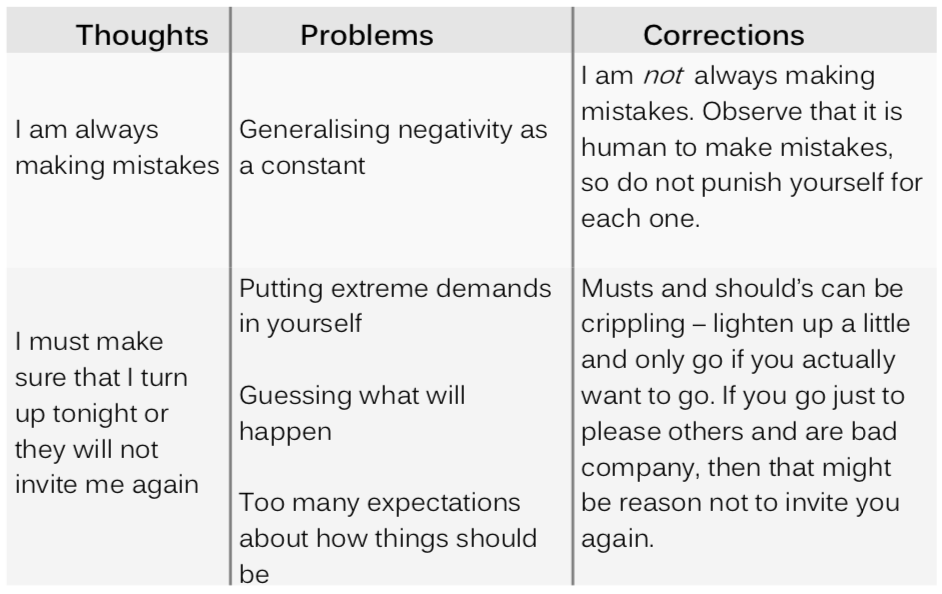
Incorporating this method into a diaryEach entry on your diary has the following format :
Situation :Sat in a coffee shop next to a person who had finished her drink when I arrived, but stayed the whole time I was there without buying another.Emotions :I felt a little disgruntled that she should overstay her welcome - I always leave shortly after finishing my drink.Thinking :That she should get another drink or leave.Problems :
Corrections :My concern was petty - there were plenty of spare seats, so no need for her to vacate hers. The negative feeling of a sense of injustice started eating at me and began to make me want to judge her (but I was fortunately able to stop).Outcome :I calmed down, but when saying goodbye I could feel some residual judgement. So I will try to ignore this thought in the future as it serves me badly, and it will eventually fade away.Recording expected outcomesAn unexpectedly effective method for realigning your thinking is to record expected outcomes when you are due to face a situation that you are dreading. Record a score of how bad you think it will be, and, if possible, what will likely go wrong. Often, your expectation will be over-rated because humans are relatively poor judges of the impact of events. For example, after the initial euphoria of winning the lottery dies down, you will not stay happy - you will return to much the same happiness set-point as before. Even more surprising, the devastating loss of limbs in an accident will make you pretty miserable for a while, but you will likely adjust and eventually be just about as happy as before. These matters have been born out by research. Again, by writing down expectations, we become more aware of them, and can more readily compare them to the outcome. Our memories of expectation are simply too unreliable to be trusted as guides. Breaking barrier thoughtsSome thoughts we have act as barriers to progress, or simply to doing basic things in life. Questioning these can serve to neutralise them, and peal back layers of damaging thinking. Some examples will serve to drive the point home ...Thought I can't help others with their problems because I am not qualified. ChallengeWhat is most important are qualities such as empathy and a caring approach. Without these, qualifications mean nothing.ThoughtThere is no point in vacuuming the carpets in my house as they will only need cleaning within a week anyway.ChallengeThis barrier to action is very common, and in part understandable. But what is missed is the feeling of achievement after cleaning, and the sense of empowerment that gives. A clean carpet will be appreciated also - it is all too easy to assume that it is worth putting up with a carpet needing cleaning.Analysing deeperOne technique for finding the core beliefs that undermine many others is to carry out a 'But and Rebuttal' analysis. You challenge one of your '... but I cannot ...' statements with a series of rebuttals, talking with yourself as if you were counselling someone else, as illustrated here :ButI really should do some revision, but I cannot be botheredRebuttalYou should suffer short term pain for long term gainButBut it's not worth the effort as I won't get a good grade anywayRebuttalYou cannot know in advance what grade you will get. Why take the risk with something so important?ButBut even if I get a good grade, I will never be able to get a job.RebuttalAgain, you are forecasting the future. Why do you think you will not do well?ButMy Mum always said I was never going to be anything in life.This is a somewhat shortened dialogue, and an extreme example, maybe, but it should illustrate the way beliefs can be stacked up against us. Here, the person is living out his mothers' repeated damning statements, which serve to sabotage anything that contradicts the core belief. A belief, in this instance, that was created by another. Seeking and using feedbackJust as pupils in school need feedback to know how well they are doing, a teacher needs feedback from the pupils to know if the teaching is being effective. So it is with changing beliefs. We can benefit from feedback that the new belief and behaviour we are adopting will bring about benefit, or that the belief we are dropping is indeed worth dropping. This is not always the case, as anyone learning to change their tennis stroke can testify. So we often need to be proactive in looking for signs of benefit, to pull us forward, negating the effect of the old habit pulling us back. We can recruit the RAS to good effect by priming it to seek out feedback to endorse our new beliefs. AffirmationsAfter determining what beliefs and/or behaviours are letting you down, the process of changing them can be enhanced by affirmations - the repeated reciting of a new way of thinking or behaving. For example, to say to your self "I will always do what I promise to do" often enough for it to become established as a part of your subconscious. Feeling the importance of these affirmations when you speak them will improve their effectiveness. It is much like the standard salesman technique of stating in front of a mirror how successful you are - the RAS will believe it and seek out opportunities to make it so. Be reasonable - repeating that you will be the next Prime Minister may be wonderfully ambitious, but will not be effective if there is no hope of it happening. We must also not aim for a target and create undo pressure by not allowing for mistakes in achieving the target. Other waysFor some people, myself included, affirmations feel too American, and I cannot perform them with enough belief, so I do not use them. But we can still employ other techniques. For example, if we simply act like the person we want to be, we can become that person. We can also reframe a bad habit in a way that defuses its power. For example, if we fear socialising, we may choose to allow ourselves to make 2 social mistakes without punishing ourselves, for the simple reasons that other people make social mistakes, and that it will help relax us, at least for a while. We might also look to see if and when other people make social mistakes. All too often, our own shortcomings blind us to the same or similar in others. Due diligence is requiredThe crucial factor in the success of belief and habit changes is in their due application. I repeat again that it is not sufficient to read a self help book - you must apply its methods. Without doing so, it does not matter if the methods look too simple to need paper work. You will achieve very little without following the due process. It is akin to reading a muscle building book without lifting a finger. For once, bureaucracy is important. One of the obvious reasons that a new habit struggles to replace an existing one is that the old and new behaviours exist and operate in different parts of the brain. The existing habit is run on autopilot by the subconscious, and the new behaviour that we want to become a habit, labours away in the slow conscious mind. By trying to move a new habit from the conscious mind to subconscious autonomy, you also confront an additional problem. It is worth repeating that in spite of not serving you well, the existing habit is inside your comfort zone, and the new way normally feels alien and uncomfortable. Your subconscious wants to reject it, since it does not want to move out of the comfort zone. For example, when trying to correct poor technique on your tennis backhand, the new method will tax your muscles in a different way. A better way, but something that initially feels alien. Despite being a well established correct technique, the new way will initially feel awkward, and your mind will urge you to resist and revert back to the comfort of your existing weak, but ever-so- familiar, sliced backhand. You will often feel that you are literally 'not yourself' when trying to embrace a new or changed behaviour. This simple matter alone creates a large failure rate. By way of example, I laugh a lot more than I used to, often at things that are, in hindsight, actually not so funny, because I chose to start laughing more as a basically good idea. It often does feel a bit contrived to be laughing when I normally would not. But it does not matter if laughter is contrived - most forms of laughter are benign and beneficial. By adopting this new behaviour, I now find more things funny, and life is easier. (As an aside, it is really worth adopting the twin mottos that you should not take yourself too seriously and also not take life too seriously). You may not feel that you are being yourself, but I chose to laugh more in order that laughing more becomes my true self. But in the transition period, diligence, belief and determination are required. And here comes another problem with our natural resistance to change - if we perform badly using the new method, we rapidly reject it as unworthy of further effort. It is like our new fitness regime that was going fine until we had to miss one of our sessions, and we never got back on track afterwards. We must remain diligent, repeating the new method, overriding the instinct to reject it. If we apply it often enough, it will bed in, and bear the fruits of its correctness. The subconscious will eventually start rejecting the old habit in favour of the new way when it can see tangible benefits. But until then, you must be stubborn in order to avoid regression. Also, if you do regress, there is a common inclination to treat such a regression as a sign of failure. But you must see it as merely a temporary setback, and get back on track in order to eventually succeed. There is another pitfall to be wary of. If we start making progress with the new habit, we may plateau, and then fail to sense any progress at all. This may dishearten us and cause us to lose interest. We may actually not even see that we have made any progress at all. If we perform the same this week as last, we simply forget that the week before that we were less effective. Our memory can play tricks on us and jeopardise our efforts. By repeatedly adhering to the new route, for example, by reasoning against the need for anger and thereby diffusing it rather than succumbing to it, the new way of being becomes established as a habit, and the old way dies off. The brain operates much like the muscles - use it or lose it. By no longer using the old anger habit, it fades in potency, replaced by the new calm response. And eventually, the new way becomes so habitual, the diligence required to establish and sustain it is no longer needed. We have literally changed our brain. Even habits such as Obsessive Compulsive Disorder (OCD) can be changed. OCD can make life miserable for many, tortured by a need to perform repeated actions such as cleaning. This can be challenged by observing and accepting without judgement the urge to repeat an action. By doing so, and pausing, you can deflate its urgency. This also gives you time to observe the way in which the need is invalid. Often, OCD can happen in the brain when the emotion giving rise to an action is not placated by performing the action - the normal feedback between these parts of the brain is weak. Recognising that OCD is therefore biochemical can also help you overcome the urges - they are reframed and again weakened in influence. A really neat way of stopping the negative trains of thoughts that can blight most of us is to carry around a click counter for a week or so, clicking at each instance of a negative thought. Initially, the click rate will be high, but the mere act of counting gives attention to these negative thoughts, and an innate desire to curb them develops. The daily counts normally reduce significantly within a week, leaving the clicker much happier as a result. This may appear to be a rare example of a focus on negativity that has a positive consequence, but in fact, the focus actually is on the reduction of clicks, rather than on the negative thoughts themselves. The effect of CBT changesWhen we start identifying, challenging and eventually changing beliefs that lead to behaviours and emotions that damage our lives, we find that this has a ripple effect. Other beliefs linked to a targeted belief also gets affected, and either change accordingly, or become a candidate for us to consciously change. As a belief changes, so will our attitudes. Strangely, the opposite is also true. By changing attitudes, our beliefs can follow. For example, if you have a poor attitude towards immigrants, and can change that attitude, you will find that your beliefs about them transform as you no longer condemn them before knowing them. One of the effects of CBT is to give ourselves greater self awareness - we start to become mindful of our automatic behaviours, and that of others. But it is vital that we do so without judgement. Accepting what we see without assessing or judging it can be a powerful life skill that goes beyond CBT - it is the Eastern philosophical extension of CBT in effect. |
|
|
|
Mindfulness and other Eastern ideas |
|
As explained earlier, our genetic inheritance includes a mix of selfish and cooperative instincts. These instincts manifest as emotions and behaviours driven by those emotions. We are all aware of these instincts, we all go along with them most of the time, but few of us have been taught to question their legitimacy. Asian countries have questioned them, and in doing so, have developed a suite of tools to both liberate us from the ill effects of those instincts, and help us steer a better path - to own and determine our future, rather than be pushed and buffeted by archaic instincts and circumstance. I do not hesitate to say that this mostly stark omission in our education system represents a massive missed opportunity to help nurture and develop healthier and happier individuals and societies. The potential effect on most people of the Eastern concepts outlined in this chapter is no less than breathtaking. We overlook millennia of philosophical, spiritual and downright practical wisdom in the far East at our peril. A key assumptionUnderlying a lot of our weaknesses is an assumption that how we naturally behave is necessarily always correct. If we are attacked, we defend. If we are hurt, we feel upset, and maybe seek retribution. And so on. If our group senses are threatened - if we discover someone is taking advantage of our group - we instinctively seek to correct this injustice. These genetically driven behaviours are essentially automatic ones. It is natural to go with their flow as they generally operate in our best interests. But not always. And this fundamental matter is where mindfulness comes in. And before I proceed to talk further about this Eastern concept, I want to highlight it as the most interesting and useful mind skill I have ever encountered. Bar none. So if you learn nothing from this book but to be mindful, then you are likely to gain enormously in your life as I have done so in my own. Oh, and one more thing - mindfulness might well make you laugh at yourself. A key assumption is that our genetic inheritance is some form of mandate - a deterministic thing. It neither is, nor could be deterministic. The simple, narrow thinking that sees us as selfish and competitive, and begrudgingly sociable, denies the authenticity of behaviours such as empathy and altruism. But behaviours that arise from a long term need to survive and perpetuate are not all hard-nosed and selfish - they are simply behaviours that statistically will have that benefit. Altruism, for example, can mean we have a tendency to give up our life to save our children from death. This sacrifice does seek to perpetuate our genes, but it is necessarily not selfish in itself. Each discrete genetic instinct works in concert with both other instincts, and environmental influences. Such a behaviour as altruism, therefore, can get decoupled from that long term genetic cause and manifest instead as altruism towards complete strangers, for example. Behaviours are, therefore, not slaves to genes. There is no precise gene-behaviour relationship in survival terms. It illustrates the danger of a kind of linear thinking to believe there is - the kind of cause and effect thinking that we frequently try to apply to the world. The reality is a probabilistic one - our genes are drivers of behaviours, but do not and cannot mandate the precise nature of such behaviours. Our genes, for example, tend to coerce protective behaviour towards those closest to us. We are generally more likely to protect our closest kin - to ostensibly propagate our genes. But genes are not expressed in a vacuum - environment and other genes interact with such drives. And what if we do not like the kin we are supposed to be protective of? Will we still protect and support them? What if we do not like ourselves? Will we still seek to propagate our genes? And how can we determine from behaviours of our kin how much of our genes they actually carry? An identical twin would have 100% identical genes, but your brother or sister could, in theory, have no matching genes, inheriting instead, the half of the genes from your father that you did not get, and similarly from your mother. Likewise, when in a position to protect a family member, we may simply be in the wrong mood - environment and circumstance would then serve to undermine the genetic instinct. So our genetic urge to protect can only operate probabilistically - it is a steering force, not a black and white obligation. Genes may also become outdated - to be slow to adapt to changes in our life and environment. For example, the vision of a semi-clad or naked lady in a provocative pose in the majority of our ancestral past would normally have occurred only when an opportunity for sex was presenting itself - our arousal to such imagery matched the genetic desire to reproduce. But for some decades now, we have had printed pictures of such scenes to 'titillate' us. They should not arouse us as there is no prospect of intercourse and hence reproduction, but they do, supplying evidence that gene-driven behaviour is sometimes pretty imprecise. Even more fundamentally, we can ignore the urge to procreate even when a situation presents itself. We can ignore our hunger - even die as a result, as hunger-strikers can do. So even deep rooted, primal urges are not mandates. They may push you very hard to behave certain ways, but they have no absolute control over you. So the black and white thinking behind the idea that we are held to ransom by our genetic instincts is deeply flawed. And this opens the door to mindfulness. MindfulnessMindfulness is an Eastern idea that can bring about sweeping changes to how you live your life. The concept is pretty straight forward, yet many people believe that there is something mystical and inaccessible in Eastern ideas. This is very unfortunate, so ignore that aversion. Mindfulness simply requires you to be wary of yourself and how you relate to the world. In a nutshell, it asks that you pause before acting on emotions or instincts in order to give yourself time to observe and reflect on actions, thereby allowing you to choose to avoid an action that is not likely to serve you well. That is pretty much all there is to it. But the simplicity belies the power! A simple example is in order then. If you drop a container of milk on the floor it is easy to shout in anger. And to then mop up the mess with vile obscenities uttered under your breath. This will leave you in an emotionally jarred state, one that may take some time to dissipate. If, instead, you pause, you will observe - you will be mindful of - the rapid appearance of the anger emotion. The key is to simply observe it and not buy into the message it is imploring you to act on. This gives yourself time to reflect on what has happened, so that you can quite sensibly and rationally realise that the deed is done - it is too late to stop it happening. There literally is no need to cry over split milk and so you can simply and calmly mop it up. When you do so, you will not be doing it begrudgingly. The emotion will not have taken a foothold but will have already started to fade. It is vital here to see that you have not suppressed the emotional reaction to the spillage, but simply defused its urgency and message by re-framing the situation that caused it, and thereby removing the emotion's legitimacy, hence deflating it. Suppressing emotions is generally a bad idea as they can fester inside you and then later resurface with greater potency. So you neither ignore, express or suppress emotions but simply see them differently so that the wind is taken out of their sails. But, you will say, the emotion still happened. Of course, this is reality. However, each time you repeat this mindfulness, the emotion will express with lower intensity, and the instinct to simply and calmly clean up the mess will start to acquire greater focus. Mindfulness therefore nurtures changes in habits. When this happens to me now, I no longer feel any anger at all. It is therefore quite relaxing to deal with something would formerly have been stressful or irritating. More obviously stressful is when we become engaged in a heavy argument - when we get really angry. The problem here is twofold. First, we generate high levels of adrenaline and cortisone that are caustic to us as well as slow to dissipate (as much as twenty minutes from the point at which we start to try to calm down). Second, it narrows our view of the argument - we literally will stop seeing any position that contradicts our own. This ability to stand our ground and win arguments has its place, but it is also very damaging to relationships and our own health. Mindfulness at the start of an argument can stop the escalation of emotions. It can also open a window into the viewpoint of the other person. We might then realise that we are actually wrong and simply agree with the counter view. That agreement may be tricky for ego reasons, but this is simply another opportunity for mindfulness to intercede. Pausing after realising we were wrong allows us to see our ego wishing to grab some compensation by only begrudgingly agreeing that the other person was right. So we apologise earnestly instead. Surprisingly, that will make us feel better about ourselves. But a third opportunity for mindfulness can then arise if the other person then tries to taunt us for being wrong. Again, if we pause and are mindful, we can avoid the temptation to feel hurt. Instead, we can remain calm and unruffled and come to the realisation that they are being petty. We can feel a little sorry for them, but not patronisingly so. If you remain calm, you may quietly earn their respect. This should illustrate how invasive automatic behaviour is in our lives. It permeates a large part of our daily life and habits. Starting to see the egoAfter enough time spent practicing mindfulness, you will start to see a disconnect between your conscious mind - the reflective state in the pause - and the subconscious mind/body communicating its needs and desires. And because you start to observe, without buying into the urge or instinct, you begin to properly see some of your more nasty ways - ways that have served your ancestors well. For example, the urge to take umbrage when someone corrects you. You start to see how much you operate on autopilot, reflexively, unquestioningly acting on instincts. And you now start to see how you do not need to do so. Gradually, you start seeing the ego manifest - often childishly defending your position in the light of contrary information. Without the pause to reflect, you are often propelled into action, and become embroiled with something that only hindsight might then see you regret. The point about mindfulness is not to entertain some fancy Eastern concept, but to make your life smoother and happier. It is useful for the simple matter that subconscious and bodily communications fail to come with value labels. We may have an urge to do something for reasons that our conscious mind would deem invalid. We may get irritable because our body is not well rested and keeps complaining to us, urging, for some strange reason, to get grumpy, as if that would correct the bodily problems. Ignoring the urge to be irritable works - the urge does pass and you relax, accepting the bodily complaint as something to be contended with rather than complained about. I often get caught listening to someone speak at length while, at the same time, my mind is desperate to interrupt with my viewpoint on the topic of conversation. Without mindfulness, we might suppress or concede to this desperation, but develop no real consistent improvement in listening as a consequence. Being wary of it, we can strike a balance between the two. And there is another facet of mindfulness - that such urgent subconscious requests are not directly caused by our conscious mind. They come from me, but not from the part of me engaged in the conversation. So I cannot blame my conscious mind - what I see as me - for such subconsciously generated requests. As a result I no longer see these requests as weaknesses since I never asked for them in the first place - much as I never asked for my genetic inheritance. And that is relaxing. But it does not, however, stop me taking responsibility for modifying these habits - to try to work around their anti-social nature. One final matter about mindfulness - it is not limited to managing destructive emotions. It is also about seeing the world as it is - to take in the colours and smells and sounds around us that normally wash over us as we rush around on auto-pilot. Fixing cooperation problemsChapter one explained our cooperative natures, but additionally explained that we are also genetically influenced by some pretty primitive instincts that arise from group cooperation. For example, we can be petty minded in our vigilance of people to ensure they keep obeying the group rules. We can ourselves sneakily bend the rules to gain more than we deserve, and dismiss such immoral behaviours as exceptional or trivial. Like failing to tell our bank when the cash machine gives out too much money. The really important factor to observe here is that our inherited instincts are characterised by immediacy and by therefore lack a long term context. They seek short, sharp, effective remedies to perceived problems. By rising above these instincts, we can live our lives with a long term, strategic focus. Rather than 'react and regret', we can treat indiscretions as relatively trivial, short term matters - if we are mindful, we can start to choose what instincts we follow. Let me look at motorway driving for an illustration. Sharing a three lane motorway is a classic example of group cooperation to generate group benefits. Many cars can drive simultaneously - the motorway can handle a large volume of traffic - because we all tend to follow the highway code. The rules of the road. But we often do so we our cooperation deception and detection behaviours in action. We may engage in a slightly dangerous overtaking manoeuvre and dismiss any concerns because we are a better driver than average (nearly everyone thinks this, but only 50% can be). Yet if we are ourselves overtaken in the same fashion, we cry wolf. If we remain mindful in both instances, we can learn to avoid unduly risky behaviours, and also temper our judgement of others in the light of hypocrisy - we are now aware that we also bend the rules at times. We may get caught behind a slow car whose driver refuses to budge to the inner lane, and we can be mindful of the urge to get angry - to try to blast our horn at him to do the 'right thing'. We want to punish him for not cooperating with the rules. But if we can be mindful of the reality that he will move when he is ready, we can stay calm - what we cannot change is best accepted. There is a simple observation you can make about your emotional reaction to other drivers. How often will you label a car driving faster than you as reckless and selfish, and how often label the driver of a slower car as old and inept? This ego-centric view of the group of you sharing the road places your speed at the centre of the universe. As the morally and technically correct speed at that precise moment. As you can guess, being stuck in traffic jams is also best dealt with mindfulness. You might stay calm enough to work out a better route via the next junction. Or you might be calm enough to have enough energy left at work to make up for your lost time. Another problem with typical group behaviours is the tendency to treat people outside your group as inferior. Strangers especially so. My habit of talking with strangers on a daily basis can indeed backfire, as it can intrude where intrusion in unwanted. But it mostly allows me to extend beyond my group boundaries, learn about others, and start to feel I am a part of a big whole. Much of Eastern philosophy is about that concept of connectedness, yet 'individualistic' countries appear to reject that notion outright. Really seeing the people around youWhen you become mindful of the people around you, disregarding any emergent desires to judge them, you can start to see them in a very different way. A young friend of mine is frequently seen as brash, mostly because he can be just that. And more. Russell Brand, is likewise very forward and confrontational. With the economy-seeking nature of our mind, it is no surprise then that most people will pigeon-hole them. But if you look beyond this facet of their nature, you do not just see more of the same, but what you see is entirely at odds with the brashness. There is huge depth, intelligence, insight and thoughtfulness in their natures. After a year or so of knowing my friend, only now does mindfulness of all that he is reveal a mature adult perspective in his personality. He is an unpolished nugget - how he develops is crucial to his prospects. I just try to help him and persuade others of his full character. To help them see beyond his obvious flaws to the less obvious, but more profound potentials he has. By contrast, some people cultivate an immaculate reputation, but if you are truly mindful of how they behave, you may start to see how they manipulate their image. A kind of passive forcefulness of nature that is ultimately selfish, at odds with their status. Do not judge them for this, but allow yourself to be aware that they may not be all that they seem. Fixing split mind problemsWhen your subconscious mind runs the show on autopilot, being mindful that its role in your brain can be powerful. We can accept that it can carry out deep thinking in a way our conscious mind cannot, and also accept the reality that it will often not explain how and why it decides as it does. If I find myself happy - if my subconscious decides all is fine - I can be mindful of that and enjoy it without falling into the trap of finding out why I am happy (because it will probably not tell me the full answer) nor falling into the trap of trying to hang onto that state of happiness. Try hard to stay happy and you just might push it away. Mindfulness encapsulates the Taoist concept of acceptance. When we pause, we observe and accept what has happened and the emotions that arisen. AcceptanceIf you try to live a life that depends on controlling the world, you can set yourself up for a frustrating existence. But many do persist in trying to live their lives like this. Marriage is headed for failure if each partner tries to change the behaviour of the other. Whilst humans do change, of course, expecting or coercing such change creates unhealthy attitudes, and is likely to end on frustration. Your partner is likely to be treated as second best until they change. And as been pointed out before, we run the risk of keeping happiness in check until all the things in our life that need fixing are fixed - until we feel that all aspects of life have changed to suit our needs. As if that is ever likely to happen anyway! The converse to the need for change is the acceptance of how things are, no matter how bad they might be. Sadly, most people stop before they even start to adopt an accepting attitude because they feel it is a passive, submissive approach to life. They fear that they will be downtrodden, unable to do anything about the things in life that annoy them. But acceptance is very much not this. Acceptance is blindingly simple in its initial premise : Accept that the world, and that includes you, is the reality for you right in this moment. Accept that you have a stomach ache. Accept that the grass needs cutting. You should accept 'what is' because this is reality. Do not fight what is. Accept that you have just spilt your tea. But even accept that someone has just stolen your car? Yes, because the key to acceptance does not end there, as many mistakenly believe. This first step is an alignment with reality. You accept that you have just discovered that your car is gone. You accept it because it has happened, and you cannot change that fact. However, acceptance does not leave you hopeless and helpless. It does not stop you then taking action if appropriate. You should contact the police and ask neighbours if they saw anything. But by accepting what is, you do not fight reality. You are in harmony or synchrony with it. And the key benefit of acceptance here is that you do not complain about what has happened. Complaining will not reverse the situation, but will instead leave your brain in a negative frame of mind, often making you seek retribution. Accept and then react, if appropriateThe key to all these things is to stop focusing on the emotions and consequences of your loss, dislike, injury, illness, or whatever, by first accepting it, and then taking action if and when this is appropriate. This therefore avoids the repeated and entrenched worrying that can follow from a repeated focus on the problem. Avoiding unnecessary worry is good for your health. We should either take action, plan for action if not immediately possible, or take no action now if appropriate not to. There should be no room for worry, since worry is a call to action. If we take action, the worry is being satisfied. If we cannot act, then we should defuse the worry. If we have to defer action, we can also defuse the worry because we have taken action to determine when to take action - any time spent worrying before then is pointless. There is a saying about accepting your plight that you may know: "It is not what happens to you that matters, but how you react to what happens to you that matters." I will rephrase this proverb a little : "It is not what happens to you that matters, but how your conscious mind reacts to how your subconscious mind reacts to what happens to you that matters." This is somewhat long-winded, but the point here is that our 'reaction' to something is not a neat, encapsulated thing, but more a series of interrelating events, starting with an initial and rapid assessment of the event by the emotion centres in your brain. Our lumbering conscious mind is given this emotional assessment in the form of a colouring of the perception of the actual event. For one personality type, the conscious mind is given a calm, measured picture of reality by their subconscious. In another type, the colouring is in the form of a heightened emotional state. The latter predisposes the conscious mind to be less rational and maybe over-reactive about the event. The appearance of the same event to the conscious mind of different people can vary enormously by virtue of this initial emotional assessment by the subconscious mind. If you can recognise that these emotional flavourings to your perception of reality are making life hard, you should look to detach from them. Try to reduce how much you accept your subconscious mind's initial evaluation of situations. For example, if you get anxious, with a heightened heart rate when you see someone who you do not always get on with, then this may help you avoid them. But it actually may be your conscious desire to get on better with this person. So you should not engage with these emotions so that they may calm down. You might try to visualise a great conversation with them instead before you start talking with them, for example. A benefit of acceptance is that you start to free yourself from regrets, and go more with the natural, largely unpredictable flow of life. You stop reliving the past so much. You do not, for example, keep reliving that moment when wine was split on your skirt. You move on. Feeling a sense of ongoing injustice anchors you in the past, just as relentless projections into the future can do. It is worth repeating that acceptance does not mean submission. By initially calmly accepting what is happening, rather than going into a rage, you can seek a more appropriate and valuable response. One that is less likely to damage relationships, or your health. Simply reacting to your initial gut response can lead you in the wrong direction. You might shout at your son for bumping into you, which caused you to spill your tea. If you had accepted that he had bumped into you before you have a chance to react, you are more likely to explain to him how tea can stain clothes and burn skin. By speaking calmly to him, he is more likely to take heed of what you say, and maybe learn a lesson, rather then feel the need to defend himself from a torrent of angry words. I recently starting noticing that when I am chatting with someone, I am mindful of what they say and do, but make a concerted effort not to judge them for it (acquiring and retaining such an ability is as ongoing a matter as maintaining good physical fitness). I am aware that they may interrupt me, much as I frequently interrupt them. Or that they may blatantly ignore what I say, choosing to switch to a topic of their own interest instead. I do not have to turn a blind eye to these features - I can observe and be aware without judging them for these ways. Accepting without judgement does not mean averting your attention away from such matters. But because I do not judge them, I work around these minor difficulties and remain happy to be with them. I separate their behaviours from them as people. Try this and see how very relaxing it is! Really seeing the world around youThere is a more subtle aspect to the acceptance philosophy. The concept of pausing so as to be more aware of the world around. Here, there is no triggering event - this is a case of ongoing mindfulness. By adopting this stance, you will start to see things as they really are. Often, we walk around in a slightly defensive mindset, looking to avoid bumping into people we would prefer not to speak to. This transfers into a more general failure to be fully receptive to everything around us. If you can walk along the street and accept all that you see without judgement, you will start seeing beauty in the simplest and most unexpected things. I vividly remember coming out of the cinema a few years ago, having been fortunate enough to see a heart-stirring film, where the rich colours portrayed in some scenes had a powerful emotional effect upon me. As I walked along the night-time roads, I found myself much more aware than normal of the brilliant colours of street and car lights and the breathtaking inky black of the background. This drew me into seeing details in buildings, as if I were a child again. An adult will see some buildings, but a child will see these buildings, with all their uniqueness, and this is how I felt. I paused to observe all the details around me in a kind of relaxed but very conscious trance. I felt free from judgement of what I saw, and free from the judgements of those around me, who might well have seen my behaviour as slightly odd, as I stopped every few moments to look more closely at something. At anything. Because all I saw seemed equally marvellous. There seemed to be a strange correctness about the appearance of everything. Far better for me to enjoy the mesmerising pleasure of simple details than to worry about how I looked to others. Accept the dark sideWhen it comes to our dark side, acceptance has a lot to offer. It is not your fault that you inherit the so-called 'negative' emotions such as anger, shame and disgust. By fighting them, or rejecting them, you do yourself no good. By accepting them, you are in line with reality. You do get the urge to be angry if needed. You can get to feel jealous of others. You can feel shame when you do something to seriously upset someone. This is your genetic heritage. By accepting this 'dark' side, and not pushing it away, you can start to accept yourself holistically. That means that you can start to relax, not apologising for yourself. Again, and this is crucial, accepting your dark side has to be accompanied by the responsibility for handling the impact of your dark side. But by no longer seeing the dark side as defining you (since you did not choose to have the capacity for these dark emotions in the first place), the health of your self-esteem is not dependant on avoiding these emotions, allowing you instead to handle them in a more relaxed, objective manner. Accepting others for what they are means accepting that they also have a dark side. They too are not guilty for what they have inherited genetically. The dark side is like an appendage, and does not define them, just as it does not define you, unless, that is, it is allowed to dominate life. Likewise, choosing to accept pain rather than dull it is sensible, as I have already mentioned. But there is a spin on this, in that not only do most of us have a natural aversion to pain, but we get to see pain as an enemy. We get to hate coming down with a cold, rather than seeing it as a natural part of life. Suffering is part and parcel of life. When you start accepting that, you relax about life and start to take it in your stride. Stop fighting your cold and you will likely heal faster. Easier said than done, of course, as it can take a lot of mental discipline to accept suffering, but it is normally worth all the effort. By accepting this other dark side of life, you lower your defences, and lowered defences here will mean a healthier life. Fundamentally, life is not fair, nor is it meant to be fair. This reality alone is reason enough to adopt acceptance as a philosophy. Work around problems, and injustices, and try to turn them to your advantage rather than dwell on them, and moan about them. One final point on acceptance, on a rather sensitive subject - the acceptance of others who look or behave differently from ourselves. This is a way of stepping beyond the remit of our group instincts and cultural conditioning. We do not have to be wary of strangers. I love to talk to anyone I happen to meet, with no conditions attached. Well, not precisely - I will often choose to say hello to someone I instinctively feel repelled by. Nearly always, I receive a warm greeting in response and my bias is weakened - my inherited group instincts are downgraded. HonestyThe Eastern Taoist way is not just about the suppression of the ego. It is also very much about humility, and living the honourable life. For many, this will sound like an old fashioned idea, not suited to modern life. I agree that it is lifestyle choice that has been mostly forgotten, but I believe that it is worth resurrecting for your own benefit as much as it is for the benefit of others we relate to. A cornerstone of an honourable life is honesty towards others and, crucially, towards yourself. And, yes, both of these forms of honesty are very difficult to achieve. But a coherent attitude of honesty in all spheres of your life is wonderfully invigorating. It also has a simplifying effect on your social life. Being honest about someone in their absence is likewise tough to do. Whilst it is much better not to talk ill of someone in their absence, if conversation does move to such a topic, I will try to personally respect the person in their absence. If the absent person were to walk in, I hope that I would not change what I had to say. I would hope to be as true in my words talking them as I would talking about them in their absence. If you choose to adopt an attitude of honesty, you will necessarily struggle to cast off life long habits that you were not fully aware you had. Does your sweet, friendly manner hide ulterior motives? Ask yourself if you do favours to others as a part of of a social creed where a return of the favour is expected? (This is a by-product of our cooperative instinct inheritance). Are you being honest with yourself about your own intentions? Are you being honest with others in doing favours with the right heart, or do you perform favours as a subtle form of manipulation that seeks their approval of you? Our hidden motives are often spotted by others, and they can then become wary of our intentions. Trying to see our own motives - to be honest about the intent behind our actions - is hard to do, but one that can be acquired with practice. Do you really give to charity to help those in need, or is it more likely that you are doing it to look good? Do you open a door for someone to help them through, or for the thanks your action should solicit? Do you give up your seat in a bus to look superior to those who have not done so? These ulterior motives spring from the ego, and a focus on honesty is a further way to release its grip. I try to ensure that if I say that I will do something, I will do so. This gives me great esteem, and increased respect from others as they know that they can rely on me. Being honest in all endeavours does not mean that you have to agree to all requests. It does not mean that you have to be a soft touch (although being compassionate and kind is fine). If you do not want to do something where there is a genuine choice not to, means that you should say that you will not. If you cannot do something with the right attitude, but agree to do so, you are more likely to find yourself doing it for the wrong reasons, often seeking compensation for your begrudging efforts. As I have mentioned already, being honest is liberating, even if it is hard to feel the liberation at first. But it also means that you grow in confidence about yourself. You stop hiding from yourself or others. You acquire a greater coherency of behaviour. Others trust you more, knowing that when you agree to do something, you will always do it, and do so willingly, with no hidden need for a return favour. If someone abuses such innocent giving, then you will find after a while that you will not want to give to that person, and so will start saying no to their requests. These rebuttals will more likely make them start appreciating you than become irritated that you 'let them down'. Conversely, if you always agree to the requests of others, you are likely to be taken for granted. The key here is not to arbitrarily stop helping others, but to help only when you genuinely want to (or have to), and where the help is appreciated and warranted. AttachmentsAttachments are seen as a cause of much unhappiness in life. I have in fact already covered one form of expectations. They represent an attachment to events. Attachments to material things is the other side of problem. The British popular science journal, 'The New Scientist' explored the effect of phones, the Internet and computers on our lives (Issue 2739, Dec 2009). Daniel Goleman reported that our investment in these 'vital' components of modern life is taking us away from face-to- face contact and actually depressing us. These electronic devices are in effect enslaving us. You can get a sense of this when you observe exactly how often you check your email. Psychologist Tim Kasser of Knox College in Galesburg, Illinois, has shown that a focus on material things makes us less happy. It also lowers our self-esteem, and tends to make us seek material comparisons with others, investing our happiness in the superiority of the things we own to what others around us own. Indeed, any form of comparison is doomed to destabilise our health. Addiction to these modern technologies, and especially to games consoles, damages our sense of autonomy and self competence. We are bound by the rules of a machine, and removed from interactions with humans. However, if we seek out just the experiences of modern technology, and do not allow ourselves to be controlled by these devices, then we are relatively free from their harms. And this leads to a key concept. Research has shown that we are much more likely to be happy by choosing experiences instead of material things. Much better to rent a few DVDs rather than 'own' one. There is a neat mechanism you can employ to minimise the chance that material things will enslave you. Whilst the title of his inspiring book, "Infinite self - 33 Steps to reclaiming your inner power" is a bit suspect in my view, Stuart Wilde has a massive amount of wisdom to offer the reader. He says that it is best to see the material things in your life, including your house and car, as being on loan to you. This kind of thinking is very liberating, and you have seen that a key to happiness is a liberation from attachment. If your computer is seen as on loan by the world to you, as long as you respect this entitlement, then its grip on you is neutralised. To reinforce this 'loan' concept, just remember that you take no material things with you when you die. Alas, modern life has indoctrinated many into the wrong kind of thinking. The focus on material things, and the inherent short-termism that this entails is no better illustrated than with the motor car. We are almost universally caught up in the 'need' to own a car, but fail to see the global and long term consequences. Until recently, that is, when the polluting effects of cars has become a hot topic. But this obsession with cars has caught up with us in many other ways, and this form of material possession has been hugely damaging to the quality of modern life. It is worth detailing precisely how far cars have damaged our lifestyles. It was not long before cars caused the scarring of the landscape, as more and more roads and motorways were built. The ability to drive became almost a mandate to drive. Home and work could now be separated not just by miles, but by tens of miles, making foot and cycle travel unfeasible, adding to the pollution, tiring out the commuter before they have started work, and effectively extending the length of the working day. The exhausted traveller is then less likely to have the time and energy for quality home life. Life balance is damaged. And the excessive travel can create farcical situations where someone living in Cardiff can be travelling to Bristol to work in the same type of job that sees a Bristol man travel to Cardiff. Likewise, shops are spread more thinly, with many large shops sited out of town, mostly inaccessible to those without transport. The status of the car is also elevated above of that of the pedestrian. That a human in a polluting car so often has right of way over a nonpolluting human crossing the road is madness if you are to really think about it. But when we get behind the wheel of a car, the car changes our behaviour. It corrupts us. Pedestrians are humans like us, but they move much more slowly and are relegated in importance in our eyes. So much so that most drivers will not indicate at a roundabout to inform a pedestrian of their intent. The pedestrian has to blindly wait before crossing, or guess by the angle of the wheels whether the car will exit the roundabout or not. The failure to indicate is actually a social failure on the part of the driver, but he is blinded to this by the empowering effect of the car. It is technically also a driving failure, although very few motorists know that the need to signal intent extends to road users. When a pedestrian is trying to cross the road, he is indeed a road user. But we fail to embrace such concepts because we allow the power of the car, this material thing, to corrupt our humanity. And finally, the congestion of roads, and the danger of cars has driven children inside for vast swathes of time. It stops them exploring the world, and an incarceration with electronic devices damages their health and social development. |
|
|
|
Awakening |
Altered statesIt is strange how easily we accept alcohol induced states of intoxication as normal and even vital parts of our lives. Our inhibitions are reduced, our connections with others can intensify, and our merriment can flourish. We know we are in an altered mental state when under the influence of alcohol. We know that other drugs such as marijuana and cocaine can induce altered states, even if these are classified as dangerously addictive means to those ends. And we assume that what we take is the cause of our altered states - that we must change our mind by outside influence. Yet the changes of mind are in the mind. Alcohol and other drugs merely trigger the changes in the mind. Few of us are taught that there are altered states of mind that can be achieved without using external triggers. We can profoundly alter our state of mind by using our mind alone. We already know that our thinking can change how we feel. On a good day, our positive outlook makes us more resilient, more upbeat. But this is a relatively mild change of state. I am referring now to a significantly altered mental state. Let us compare two states of mind to give scale to the profound change that I want to describe. When we first wake up and slumber in bed before getting up, we are in a dozy, semi-conscious state. An hour or so later, after breakfast, we can feel energised and fully awake. The difference is indeed profound between these two states. Key here, however, is that this 'fully awake' state is most certainly not some kind of maximally awake state we can feel. We can move about the same distance from this state to another, 'profoundly awake' state as we did from slumber to 'fully awake'. Do you believe that this enhanced state is possible for all of us, and not some special privileged state of Buddhist monks? When we are profoundly awake, the world feels hyper-real and we feel connected to it, integrated into what we see. Also, we start to lose our sense of self and move in the world in a blissfully calm manner. It feels like a fog has lifted, and that we have come out of a zombie state to be truly alive for the first time (or maybe to return to how we felt as young children before we acquired the burden of life's needs and the constraining indoctrination of habits). The transition to this state is quite distinct. There is a paradigm shift in our perception of the world. It is indeed a profound change. However, if it is so profound and enjoyable, why can we not automatically engage in this altered state much as we do when drinking alcohol? This is a very good question, whose answer I do not know. It may be that our genetic heritage is one that relentlessly seeks to maximise our survival and reproduction with too much intensity. We do take time out to escape from it with alcohol, but we are caught up in 'the rat race' so much in our zombie state that the path to self-induced altered states becomes hidden from view. Certainly, we have stopped listening to our bodies to truly know what we should eat, and to understand and listen to pain when ill rather than reflexively anaesthetise it. Culturally, the Western world has lost tribal traditions that teach the paths to internally generated altered states. The description of our normal state as zombie-like may sound rather harsh. But it will feel just that when a profound awareness is being experienced. So the term zombie is used more as a means of illustrating the degree of change that occurs in the profound state, rather than to denigrate the practicalities of our normal state of mind. Our daily life is of course not really experienced as zombie-like, but it is not so very different. We may have mindless, sleepy times and other more lucid, clear headed times. But the unifying factor is that we are mostly living automatically. We are only subliminally conscious. Our brains like to keep us in a functional state, to get things done rather than indulge in niceties like drunkenness or a state of calm contentedness. But the altered state I am describing allows us to keep on doing 'life'. And it can often let us do so with greater focus and attention. Our normal state is one of a kind of restless urgency, with nagging ruminations, future projections, and reaching out for pleasure or pain relief. In the altered state, there is a calm that pervades us. The mental chatter - the endless mental chatter and nagging in our heads - starts to become quiet. And we can deal with full focus on one matter at a time, or rest in the current moment for our full attention. Even if we are in pain. MeditationThe mechanism for this 'awakening' is meditation. As described earlier, the subconscious will chatter away to us all day long, providing a running commentary (with many judgements) about the happenings of the day, along with reminders of past woes and of future needs. Meditation is invaluable for giving us a rest from this chatter. For those who see meditation as something requiring a monk's robe and the ability to sit cross legged and hum are missing the point. The first step taught in meditation is to calm down the chatterbox. The main concept behind resting mental chatter is that we are dealing with an attentional problem. When we rest, we do not want to have to attend to matters that our minds might conjure up. We are resting and should be able to defer these matters to a later time. But our subconscious wants to keep nagging us. It nudges us for each matter it deems important because it does not have the conscious mind's access to the big picture - it cannot see when it is appropriate to nag and when not. So the chatterbox pretty well runs continuously, even in sleep. By focusing our attention away from the chatter onto a passive target, such as our breathing or the flame of a candle, we can achieve calmness. What we pay attention to again becomes our reality, and the chatter can gradually start to fade. When a constant sound was played to the ears of a subject, brain scans revealed high activity in the auditory cortex that receives and processes sound from our ears. But for the same subject receiving the same sound whilst busy on a task assigned to him, the auditory cortex activity was much reduced, as if the sound had been reduced. When conscious attention was moved away from the sound, the brain simply reduced its efforts at responding to it. The same can apply to pain as well - distraction literally reduces pain levels. Do not let your chatterbox define who you are. When you start to understand that your stream of thoughts are often faulty and also often ego-driven, you can live more in the conscious mind - you can let the higher functions in the brain rule in place of low-level functions like the ego and base emotions. After years spent on the receiving end of the chatterbox, the ego's distorted view of the world will have an accumulating effect. You are likely to have developed generalisations about the world and its people that are often crude and unhealthy. And these generalisations can stop you seeing reality for what it is. But meditation is not just the calming of distractions. It is a deep mind training methodology that has been a part of many cultures and religions for centuries. It can become a lifelong friend and mission. To sum up what it means in a single statement, meditation is : Intentioned, sustained, stable and complete attention Deeper practices build on this attentional focus to condition and evolve the mind and ultimately achieve enlightenment. But this base level is more than enough to transform lives, awakening us to that profound state I described. To start meditating, you are generally recommended to find a regular time of the day where you will not be disturbed. Ideally at least thirty minutes. Traditionally, you are advised to make yourself comfortable gently cross legged on a cushion on the floor with eyes shut. This directs attention to your body, and generally the breath - as the single constantly active, observable part of our body. You gently observe the effect of your breath on your body. You are focusing your attention on that one single thing. And sure as not, thoughts, sounds and bodily feelings will intrude. Observe each distraction and bring your attention back to the effect of the breath. That is it. At least that is the starting point for training your mind. As you practice this every day, you start to find the sessions inviting as you become calmer. Your breathing slows and you feel good in yourself. Additionally, this calm will start to infiltrate your daily life. You may find times where you just stop to deeply and calmly observe something that would normally not grab your attention. I personally find that I get greatest benefit from actively making meditative attention part of my daily life. This is especially the case when I sit in warm sunshine. It relaxes me - it always has done so - and I now often find that this puts me into a meditative trance. A kind of reverse process from the norm. So I effortlessly become drawn into calm observation of the features around me, pausing on each in turn. The pattern of bubbles on my coffee can entrance me. Even the gritty texture of a brick. You will hopefully start to experience a wonderful form of awakening where all around you seems hyper-real. A switch goes to take you into this state. The transition is both profound and subtle. When this happens to me, tree and flower colours scream at me - in a nice way - they look an order of magnitude more vivid and real than normal. Everything looks more real. More alive. I feel super alive. Yet also calm. This may not be something you experience, but there is no real reason why not if you practice meditation often and long enough. But chasing such experiences is like chasing happiness. Much better to remove the barriers to enable it to happen. To retain focus of attention and quieten down the effect of distractions. Being happy anywhereWhen you develop the ability to be able to go into a calm meditative state anywhere, you start to be able to enjoy the ability to go into a deep attentive trance in and of itself. Your happiness starts to come from within rather than from things and events outside yourself. This is truly and deeply profound. How many have meditated cross legged and never carried that meditation into their daily life without discovering this paradigm shift? It may take time to start to feel happy wherever you are, but I guess you can see how terribly valuable and valid such a skill is. Going deeperThis enhanced awareness and the calm of mind and body that meditation can bring to your life is plenty enough for most people. It is rarely taught to the masses in the first place. But there is a counter side to these pleasurable aspects of meditation - the matter of suffering. It is good to have times of calm, but when our minds are swamped dealing with pain, illness or powerful emotions and thoughts, great skill is needed to meditate and go into a calm state. Few can do this. Buddhism philosophy wants to free us from suffering. Not by anaesthetising or avoiding pain as we in the West tend to do, but by reframing how we perceive pain, illness, emotions and thoughts. We use equanimity to do this reframing. We observe and experience troubling feelings objectively, without attaching meaning or narrative to them. Suffering is such a narrative - the disgruntled and victimised sense that we are having a hard time on top of having that hard time. Narratives can expand and distort our perceptions this way. By way of example, a while back I had a third tooth develop an abscess - an infection that bombarded me with periods of 5 to 15 minutes of intense, eye-watering pain. This was before I started day-time meditation. My idea at the time was a kind of variation of equanimity. I reframed the pain as information. My reasoning was that pain is communication to the conscious mind that a body area or part is failing and to please take action. My body informing my mind. So I paid full and complete attention to the pain (hard not to as it was all-consuming) with this view to defusing its potency with this information framing. And it worked. I was able to tolerate the pain with equanimity. And when the pain returned an hour or so later, I was able to repeat the process and most certainly felt much less that I was suffering and much more that I was curiously engaged in a relationship with my body. When the dentist fixed the problem I missed the pain! Actually I did not, That would be disingenuous of me. What I did miss was being able to hold that dialogue with the pain. And this is the focal point of reframing 'causes' of suffering using meditation. You change your relationship, much as you do when meditating on something ordinary. Whilst you may not be able to feel happy when 'enduring' pain with equanimity, after the pain has gone, you will recover faster, and be more grateful. And subsequently most likely feel happier, no longer carrying the baggage of the injustice that suffering tries to instil in you. Read further to explore even deeper concepts such as impermanence and purification. With thousands of years by millions of practitioners, all sorts of aspects of meditation were explored. It can be a life-time's learning and exploration joy. |